About the Museum
The Ocarina Museum is, for now, a website, based in the United States: a shared undertaking among collectors and ocarina lovers around the world. It began with one large private collection, and others have joined it since.
By convention an instrument is photographed against a plain background beside a United States quarter, 0.955 inches (24.26 mm) across, so that its size can be judged from the photograph.
The logo
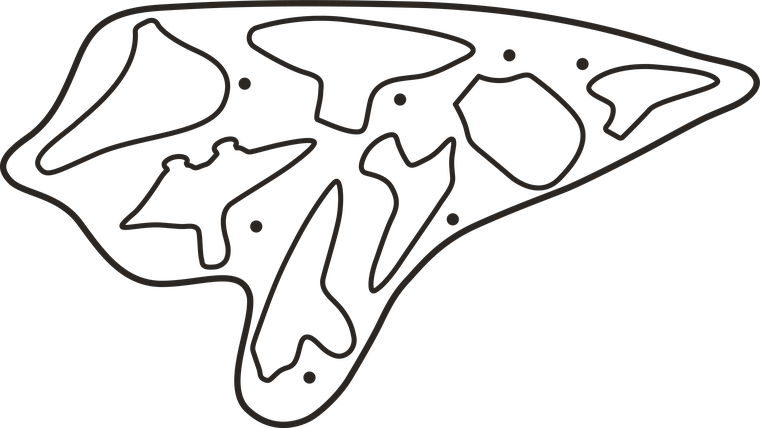
The museum’s logo is drawn from real instruments. The outline is the big Meissen ocarina in the collection, and the seven shapes inside it are each taken from a different ocarina.
The key notation
Keys are recorded as a note and a number: C3, G2, Bb3. The key is the lowest note of the instrument, ignoring the subholes — the small holes that extend the range downward. The number denotes size, loosely following the tradition of Budrio ocarina makers.
Sizes run in bands six semitones wide, and the number increases as ocarinas get bigger and lower in pitch. The boundaries lie at B♭ and E:
| Size number | Keys in that band |
|---|---|
| even | E, F, G♭, G, A♭, A |
| odd | B♭, B, C, D♭, D, E♭ |
So a size is not a pitch range in the ordinary sense. B♭ is one semitone above A, but it belongs to the next band down: the collection holds A2, A4 and A6, and above each of those sits B♭1, B♭3 and B♭5. The same happens at the other boundary, where E♭3, E♭5 and E♭7 are followed by E2, E4 and E6.
These numbers are deliberately not translated into soprano, alto or tenor labels, which are not used consistently among ocarina makers.
Other people’s work
Not everything here is the museum’s own. What it collects, what it never publishes, how it treats photographs and writing belonging to other people, and what it does when nobody can be found to ask are set out on the mission and policies page.
Colophon
The catalog is maintained as a spreadsheet, and the site is generated from it by a set of Python scripts and Quarto.
It was built with Claude, Anthropic’s AI assistant, over many sessions: it wrote most of the code, drafted text that was then revised, and did much of the searching through the Internet Archive that recovered some of the articles preserved here. What the museum collects, what it publishes, and what it owes to the people whose work it holds were decided by the museum.
Corrections
What the museum does about its own mistakes is set out in its policy, under Corrections.
If you find one, or if something here is yours and should not be, please write to theocarinamuseum@gmail.com.