A Letter on Voicing and Volume
Alan Albright to Sandi Schmidt, 1983, on window size against interior volume — how he tuned an ocarina, and how he measured one.
Written by Alan Albright in San Francisco on August 31, 1983, to Sandi Schmidt of ClayZeness Whistleworks, and published years afterwards on ClayZeness Ocarinas (clayz.com), the site she and Richard Schmidt ran in Seattle. That site is no longer online; this copy is preserved here from the Internet Archive. The words are Alan Albright’s, and he gave the museum permission to publish them on September 13, 2026. Sandi Schmidt gave permission for the site in September 2026.
Sandi Schmidt had written to Alan Albright asking how to voice an ocarina. This is his reply. It explains how these instruments were actually made, and it is a working letter rather than an essay — one maker telling another what he had found out by trial and error.
August 31, 1983 · Alan Albright · San Francisco, CA
Dear Sandi,
Thanks for your recent letter. I believe that this sort of feedback and exchange between all of us will help each of us grow in our work.
The critical point in voicing begins as you reach the octave (high do). So, you can’t tell much from a whistle which only gives you a few notes – but doesn’t go high enough to fizz out. Anyway, given the variables – the secret is experimentation.
Once you get a satisfactory solution, then it is useful to have a little tool – a jig – to gauge your window size for each size ocarina. Thus, your windows should be almost identical.
The happy/unhappy situation single – varied – ocarinas is that each note can be “adjusted” (unconsciously) by the player. One of my former partners in a pewter ocarina undertaking proved this. A whole series of castings which he had made and tuned were hopelessly out-of-tune to my ear and to those of potential customers. When I confronted him with this, he denied it vigorously – playing the scale fairly well (blowing softer here, harder there…).
Given consistent window size and interior volume, hole depth and size affects the pitch. This is more significant for me than for you. Anyway, I drill my holes undersize, then after the shape is finished, I re-size each hole. Naturally, I have all the drill bits you could imagine plus little cone shaped bits.

When your “do” is too low, it means that ALL the holes are too big. You can raise the pitch of the do with a small “tuning hole” – or by enlarging the window. This still doesn’t guarantee that the first couple of holes will still NOT be “sharp”. Trial and error!
When Nadine and I made ceramic ocarinas, I did most of the work when the pieces were leather hard. Still you have to figure that 30% reduction.
For specific keys: I’m doing that right now…
Again it is trial and error. So I make first, then measure then try again.
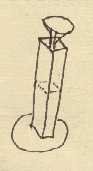
For example, “.x” ocarina with such and such dimensions (wet) becomes such and such (leather hard), then bisque to such and such and finally glazed gives: “w” window size with “v” volume. I use a pair of calipers and the metric system (which is much easier for proportions). For the volume, I made little measuring boxes out of plastic. Since I knew the cross-sectional area, then all I have to do is measure height. Thus, I fill the ocarina with salt, then pour the salt into my “box”. Measure the height and multiply by the cross-sectional area of the box. So and so many cubic centimeters.
I’m afraid that shape may also affect things. However, so far my calculations are approximate:
| Key | Window width | Window depth | Interior volume |
|---|---|---|---|
| C2* | 0.9 cm | 0.275 cm | 6.7 cm³ |
| G | 0.9 | 0.275 | 14.3 |
| F | 1.05 | 0.32 | 18.4 |
| C | 1.05 | 0.32 | 38.7 |
| C | 1.2 | 0.37 | 38.9 |
| G | 1.2 | 0.37 | 79.2 |
* Two octaves above ‘middle’ C
For a ‘rough’ approximation of the other keys, if you know the volume and name it “X”, then you can figure the volume of “Y” thusly:
“X” do = 1, si = 1.15, si(flat) = 1.32, la = 1.515, la(flat) = 1.74, sol = 2, sol(flat) = 2.3, fa = 2.64, mi = 3.03, mi(flat) = 3.48, re = 4, re(flat) = 4.59, do = 5.28
Example: If do = C = 6.7 cm³
C = 6.7cm³, B = 7.7, B(flat) = 8.84, A = 10.15, A(flat) = 11.66, G = 13.4, g(flat) = 15.41, F = 17.69, E = 20.3, E(flat) = 23.3, D = 26.8, d(flat) = 30.75, C = 35.37
Actually, this is modified by hole volume and, of course, window size.
Best,
Alan
The two small drawings are Albright’s own, scanned or photographed by Richard Schmidt and placed in the letter where they appear here. They were missing from the museum’s first copy of clayz.com and were recovered separately from the Internet Archive’s capture of May 27, 2016.
More about ClayZeness Ocarinas, and what the museum holds of it.
If you wrote this, or were interviewed in it, and would like it changed or removed, please write to theocarinamuseum@gmail.com.