Music Trades Review, 1877–1894
A London trade monthly that printed the patent lists in full, and the end of the craze
The Music Trades Review of 1877 to 1889: three patents missing from every index the museum could reach, a Paris ocarina company, two dealers at war over whose instrument was the original, and the issue in which the paper says the craze is over.
Every claim below names the document it came from, and every page image is reproduced from a scan the museum holds. Where a source is mangled, damaged, or ugly, the page says so rather than smoothing it over. Research and drafting were done with help from Claude, Anthropic’s AI assistant.
A trade catalog tells you what somebody was willing to sell. A trade paper tells you what the trade knew — and it prints things no catalog does: the patent applications month by month, letters between dealers who have fallen out, notices of firms opening, and, when a fashion dies, a joke about it. The museum has searched every year of one such paper that HathiTrust holds, and five of those years have the ocarina in them.
The paper, and its name
The London and Provincial Music Trades Review — the running title is usually just Music Trades Review, and MTR in catalogs. A monthly, published on the 15th, carrying trade news, advertisements, correspondence, and a standing patent column.
There is a second paper with almost the same name, and confusing them is easy. The Music Trade Review of New York — singular Trade, definite article — is a different publication in a different country. The museum holds pages of both, and cites the city every time.
How the museum found them
Not by looking for them. The museum was chasing a number.
Mezzetti’s own tutor carries a full-page plate headed MEZZETTI’S PATENT No. 2170, with six figures of a tuning slide. No office, no year, no country — a bare number on a maker’s own advertising. Every patent index the museum could reach was tried and none of them held a British patent of the 1870s at all.
A HathiTrust full-text search for the instrument found the trade paper instead, and the paper turned out to print the very thing the indexes had lost: the month’s patent applications, in full, with the applicants’ names and addresses.
It is there, twice. No. 2170 is a British patent of 1878, applied for on May 30 by a London agent on Mezzetti’s behalf — printed in the issue of June 15, 1878 among the applications for new patents, and again in the issue of July 15, 1878 among the grants of provisional protection. The section below gives both. Every year HathiTrust holds of the London paper was then searched, one at a time, for the word ocarina.
What the museum has recovered
| volume | pages held | what is in them |
|---|---|---|
| 1877–1878 | 20 | Barr selling by December 1877, three patents, a Paris company, and his caution against imitations |
| 1879 | 20 | a specification printed in full, two dealers at war |
| 1880 | 3 | the end of the craze, and a joke about it |
| 1881 · 1883 · 1886 · 1887 | 0 | the search returns nothing |
| 1888 | 1 | Fratelli Mezzetti of Budrio, in an exhibitor list |
| 1889 | 1 | “the Mezzette ocarina,” among curiosities |
| 1892 · 1894 | 0 | nothing |
| New York, 1879 | 4 | a different paper, held for comparison |
An empty row is a result, not a gap in the work. The search was run on every year HathiTrust holds.
What the papers say
Everything in this section is quoted from a page the museum holds. Nothing in it is inferred.
December 15, 1877 — the first mention, and it is Barr

The column is damaged and this is a reading of it, not a transcription. The binding gutter takes a letter or two out of most lines, and what is supplied is bracketed:
An instrument called an “[oc]arina” has been brought out b[y] Mr. Barr, the ticket agent, of Queen Victoria Stree[t]. The “ocarina” [ap]pears to be a sort of harmonico[n], and its tone is sa[id] to resemble the vox humana stop of a large organ.
Every restoration is near-certain from the words around it, and none of them is offered as evidence. The quotation marks, which are what this paragraph turns on, are the paper’s own — both occurrences carry them in the undamaged part of the line.
The earliest dated sentence in the run, and it is five lines of trade gossip at the foot of a column about piano sales.
What it establishes. Barr was selling the ocarina in London by December 1877 — sixteen months before the quarrel that made him visible to this project, and six months before the British patent application below. He is already “the ticket agent”, which is how the paper describes him again in April 1878. And the instrument is new enough to the writer that “ocarina” goes in quotation marks twice, and that he reaches for a harmonicon and an organ stop to say what it sounds like.
What it does not establish. Not that Barr was first, and not where he got them. Brought out is the paper’s word for a dealer putting something on sale, not a claim about who made it — and Barr’s own letter sixteen months later says his instruments were made for him on the Continent.
The number on Mezzetti’s own plate
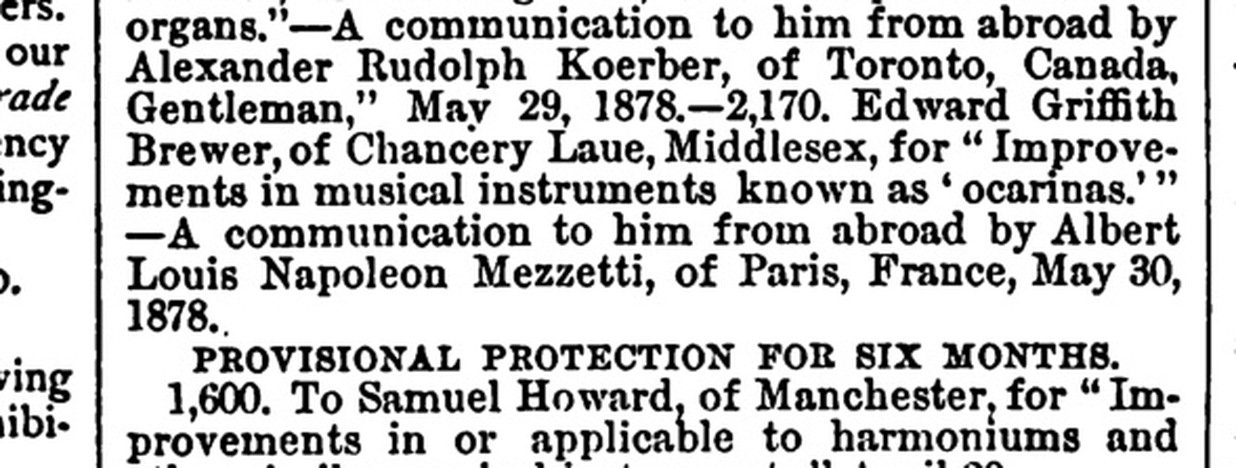
2,170. Edward Griffith Brewer, of Chancery Laue [sic], Middlesex, for “Improvements in musical instruments known as ‘ocarinas.’” —A communication to him from abroad by Albert Louis Napoleon Mezzetti, of Paris, France, May 30, 1878.
The entry is printed twice, a month apart, and the two printings are not the same kind of record. June 15 carries it under Applications for New Patents, in a column headed Registered during May. July 15 carries it again under Provisional Protection for Six Months, in a column headed Registered during June. The application was made, and then the protection was granted; the paper reports each stage in its turn.
The wording differs three times. June 15, above, has the fuller formula — a communication to him from abroad by — spells the instrument with a small o, and misprints Chancery Lane as Laue. July 15 shortens the formula, capitalizes Ocarinas, and gets the street right. Both are recorded.
What that settles. The office is British. The year is 1878. And the date, May 30, 1878, falls one day after the certificate of addition to Mezzetti’s French patent FR 124,164 of May 29 — a man adding to his French filing and crossing the Channel within twenty-four hours.
Why the applicant is not Mezzetti. A communication from abroad was the device by which a foreigner patented in Britain: a British agent applied in his own name on the foreigner’s behalf. Edward Griffith Brewer of Chancery Lane was that agent — and Brewer & Son is the agent on Mezzetti’s later British patent of 1896, eighteen years afterward.
Fiehn filed in three countries in five months
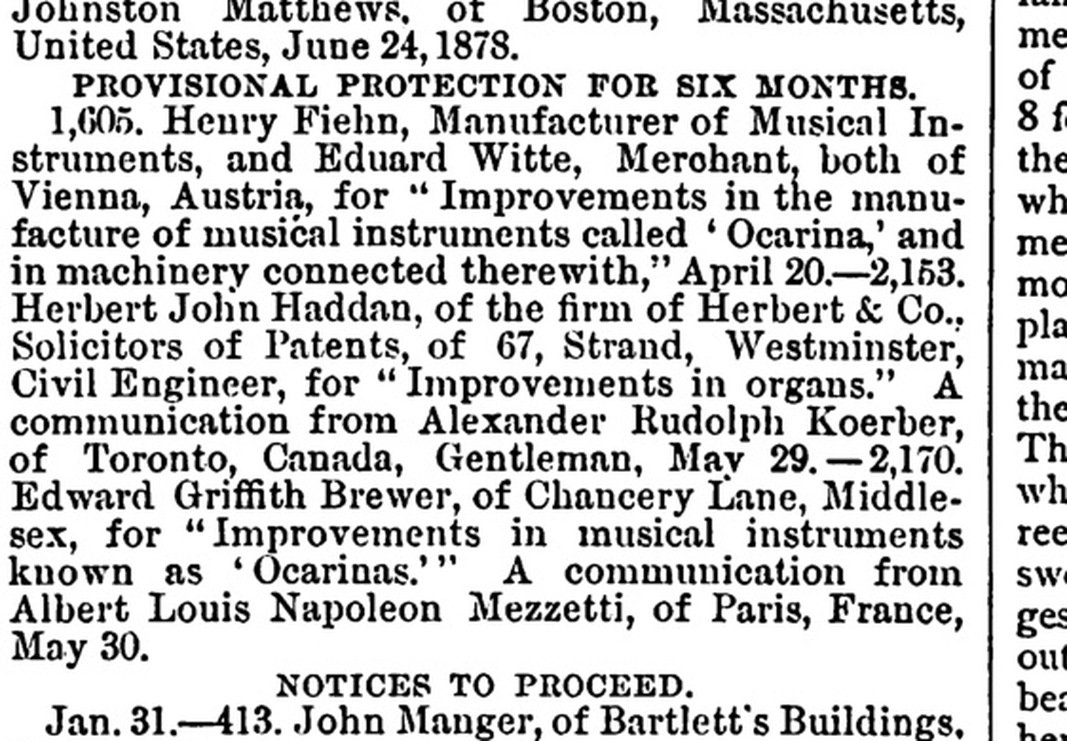
Directly above Mezzetti in the same column:
PROVISIONAL PROTECTION FOR SIX MONTHS. 1,605. Henry Fiehn, Manufacturer of Musical Instruments, and Eduard Witte, Merchant, both of Vienna, Austria, for “Improvements in the manufacture of musical instruments called ‘Ocarina,’ and in machinery connected therewith,” April 20.
And in the June 15 issue, under a standing column headed ABROAD — “Notice of Patents Granted supplied by Foreign Countries to the British Government during May” — the same man appears twice more, in the same column:
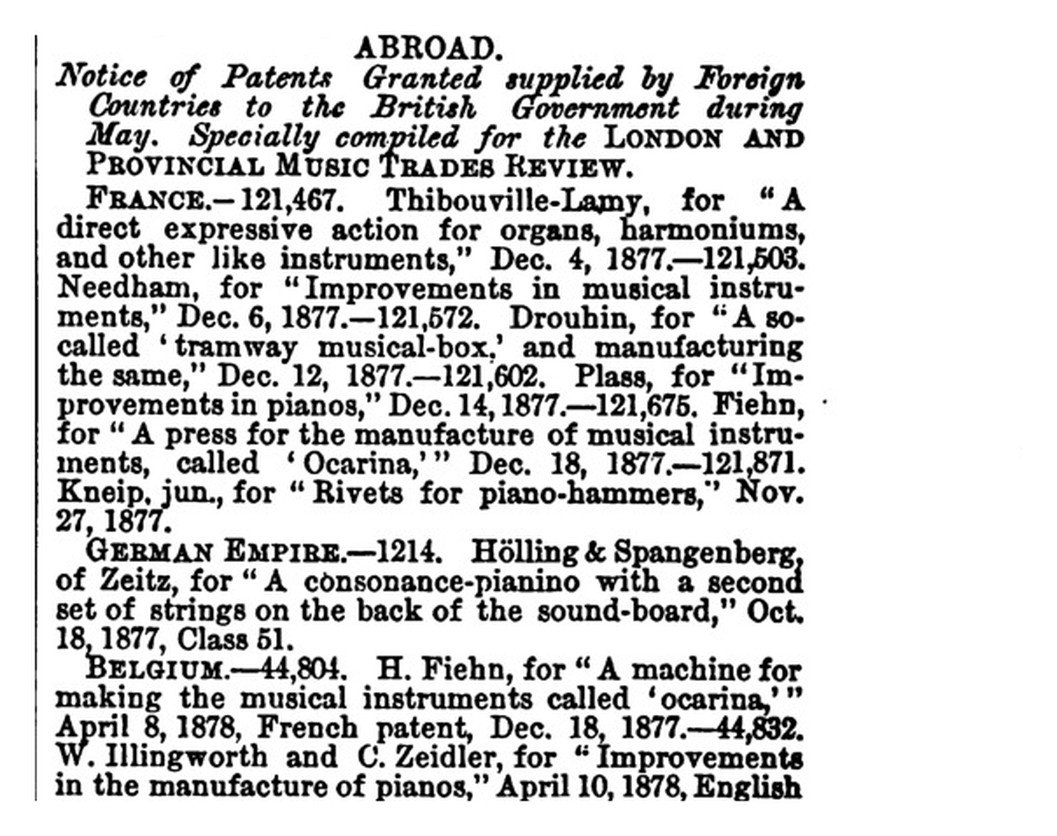
FRANCE.—… 121,675. Fiehn, for “A press for the manufacture of musical instruments, called ‘Ocarina,’” Dec. 18, 1877.
BELGIUM.—44,804. H. Fiehn, for “A machine for making the musical instruments called ‘ocarina,’” April 8, 1878, French patent, Dec. 18, 1877.
The Belgian entry names the French one as its parent, and the paper prints both. Set against the French patent the museum holds from INPI, that is:
| France | FR 121,675 | December 18, 1877 |
| Belgium | BE 44,804 | April 8, 1878 |
| Britain | GB 1,605 | April 20, 1878 |
All three are the press, not the instrument — the machine for making ocarinas. And the British entry gives the name of a partner: Eduard Witte, merchant, of Vienna. All three now have rows in the museum’s patent register, alongside Mezzetti’s.
His German patent of 1881 is a different thing, and the table leaves it out on purpose. DE 16,668 opens by describing the same press — ocarinas, in the museum’s translation, “produced from plastic clay or other hardening material with the help of an eccentric press and specially constructed molds” — but what it claims is the instrument: two keys, rings in the mouth hole and the toneholes, a mouthpiece set into the blowing opening, and a tuning slide. The claim names no material for that mouthpiece — but nine years later C. Bruno & Son of New York, wholesaling Fiehn’s range, print an ivory-mouthpiece line at 303–306 above the keyed and tuning-slide lines, which is claim 3 arriving in a price list. Three years later, and a different kind of filing.
There was an ocarina company in Paris
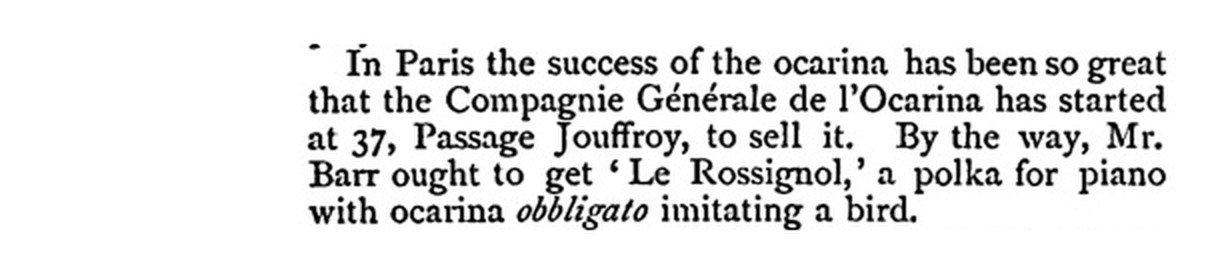
In Paris the success of the ocarina has been so great that the Compagnie Générale de l’Ocarina has started at 37, Passage Jouffroy, to sell it. By the way, Mr. Barr ought to get ‘Le Rossignol,’ a polka for piano with ocarina obbligato imitating a bird.
A firm name that appears in no other source the museum has searched.
A patent specification, printed as trade news
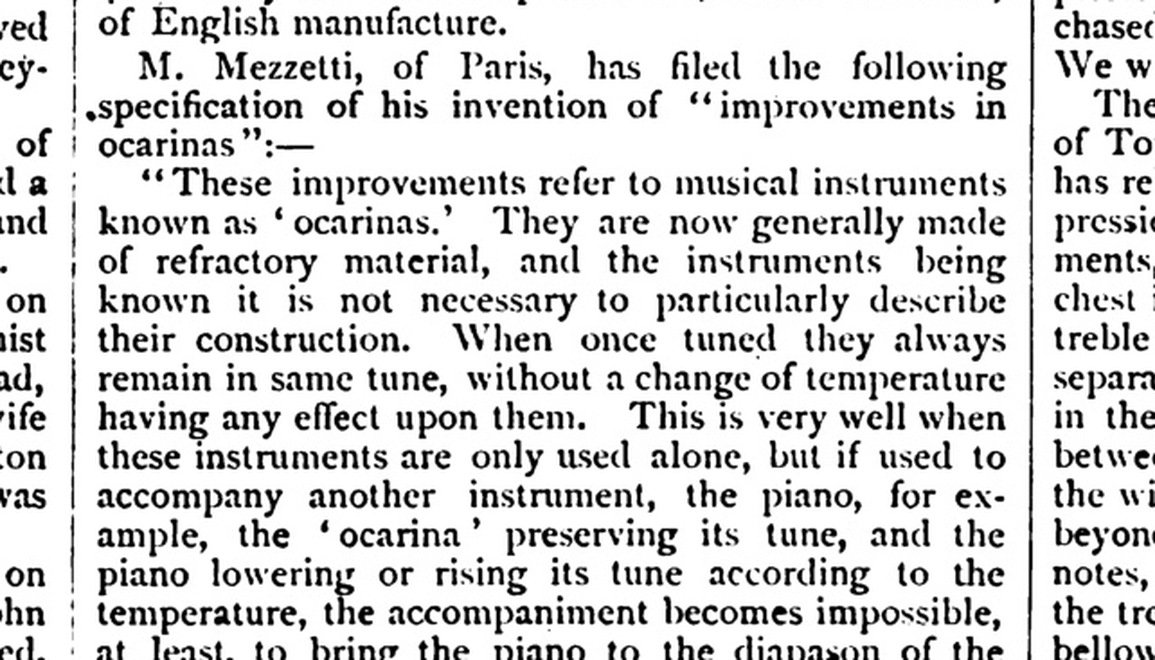
M. Mezzetti, of Paris, has filed the following specification of his invention of “improvements in ocarinas”:—
“These improvements refer to musical instruments known as ‘ocarinas.’ They are now generally made of refractory material… When once tuned they always remain in same tune, without a change of temperature having any effect upon them. This is very well when these instruments are only used alone, but if used to accompany another instrument, the piano, for example, the ‘ocarina’ preserving its tune, and the piano lowering or rising its tune according to the temperature, the accompaniment becomes impossible…”
A trade paper printing a patent specification as news is not something a catalog can do. The remedy he describes is a sliding obturator — a tuning slide.
Two dealers at war over whose ocarina is the original
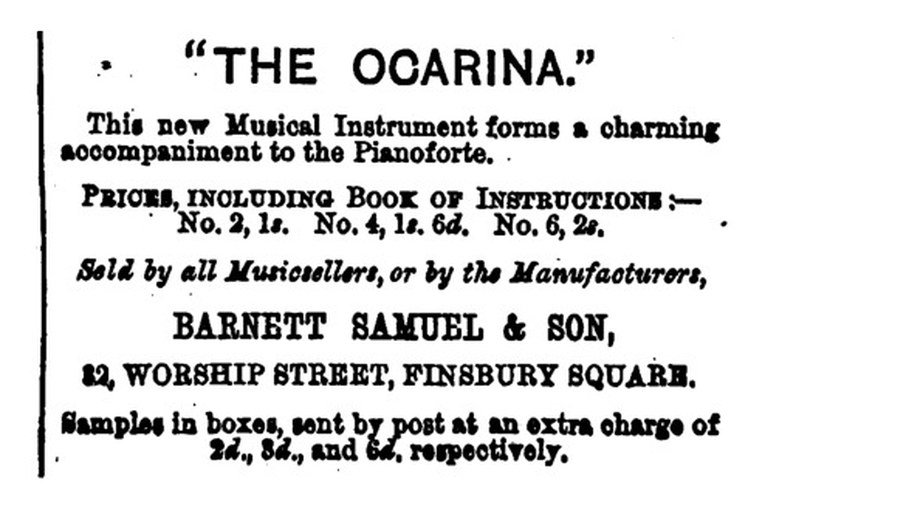
It begins in the advertisements. On January 15, 1879 both of them advertise the ocarina in the same column of the same page — Barr at the head of it, Barnett Samuel at the foot.
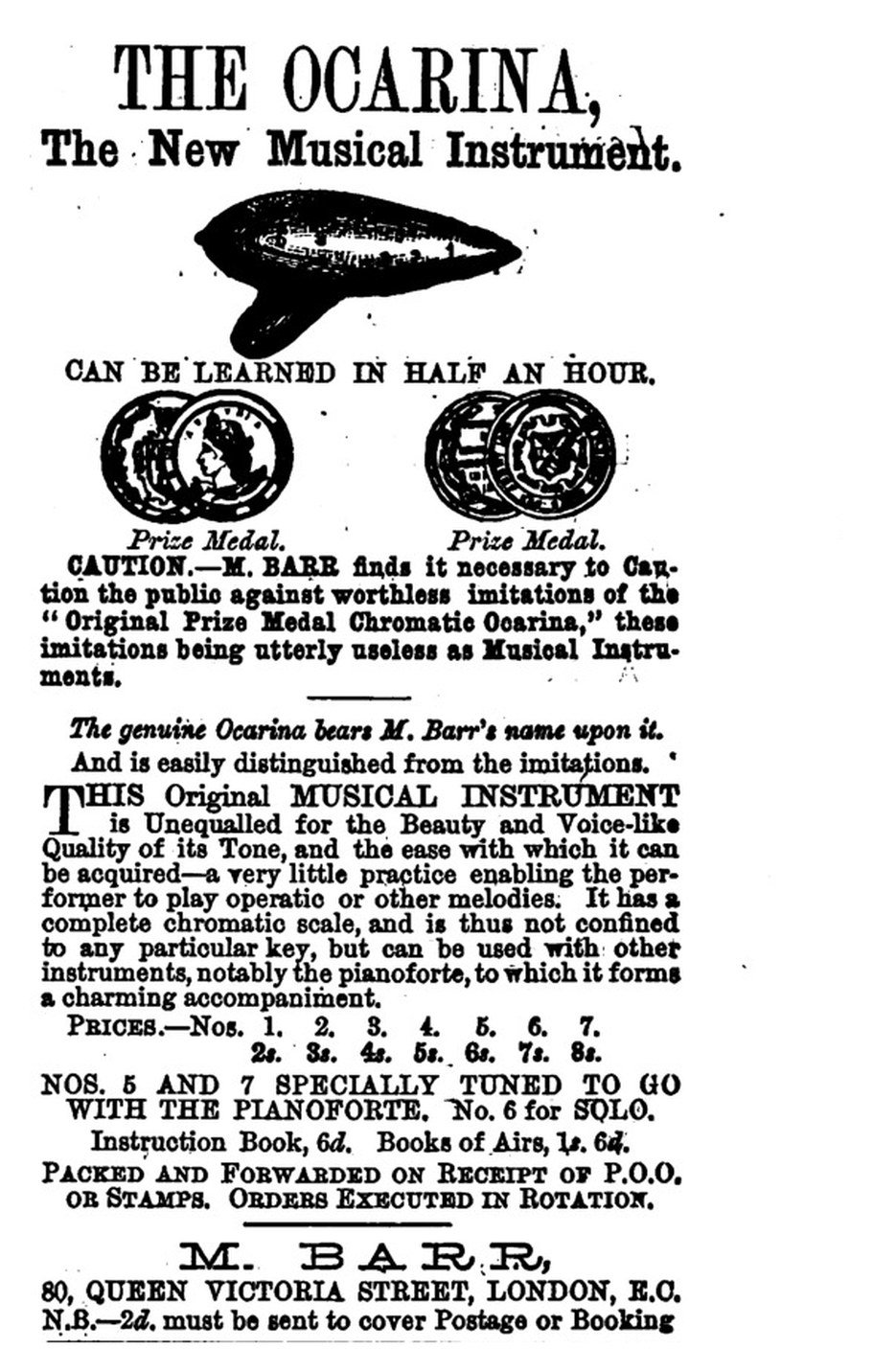
Barr sells authenticity. Two medals, each captioned Prize Medal.; a CAUTION against “worthless imitations of the ‘Original Prize Medal Chromatic Ocarina,’ these imitations being utterly useless as Musical Instruments”; and the sentence his April letter would turn into an argument — “The genuine Ocarina bears M. Barr’s name upon it.” Seven sizes, 2s. to 8s.
Barnett Samuel sells price and supply. “Sold by all Musicsellers, or by the Manufacturers” — the firm’s own word — with the instruction book included. Three sizes, 1s. to 2s., which is the cheapest of Barr’s seven undercut by half. The advertisement signs BARNETT SAMUEL & SON, singular, where April’s letter has & SONS.
In the April 15 issue both of them are in the correspondence column, with two letters printed one after the other. Both are shown here, because the quarrel is only legible with both sides of it.
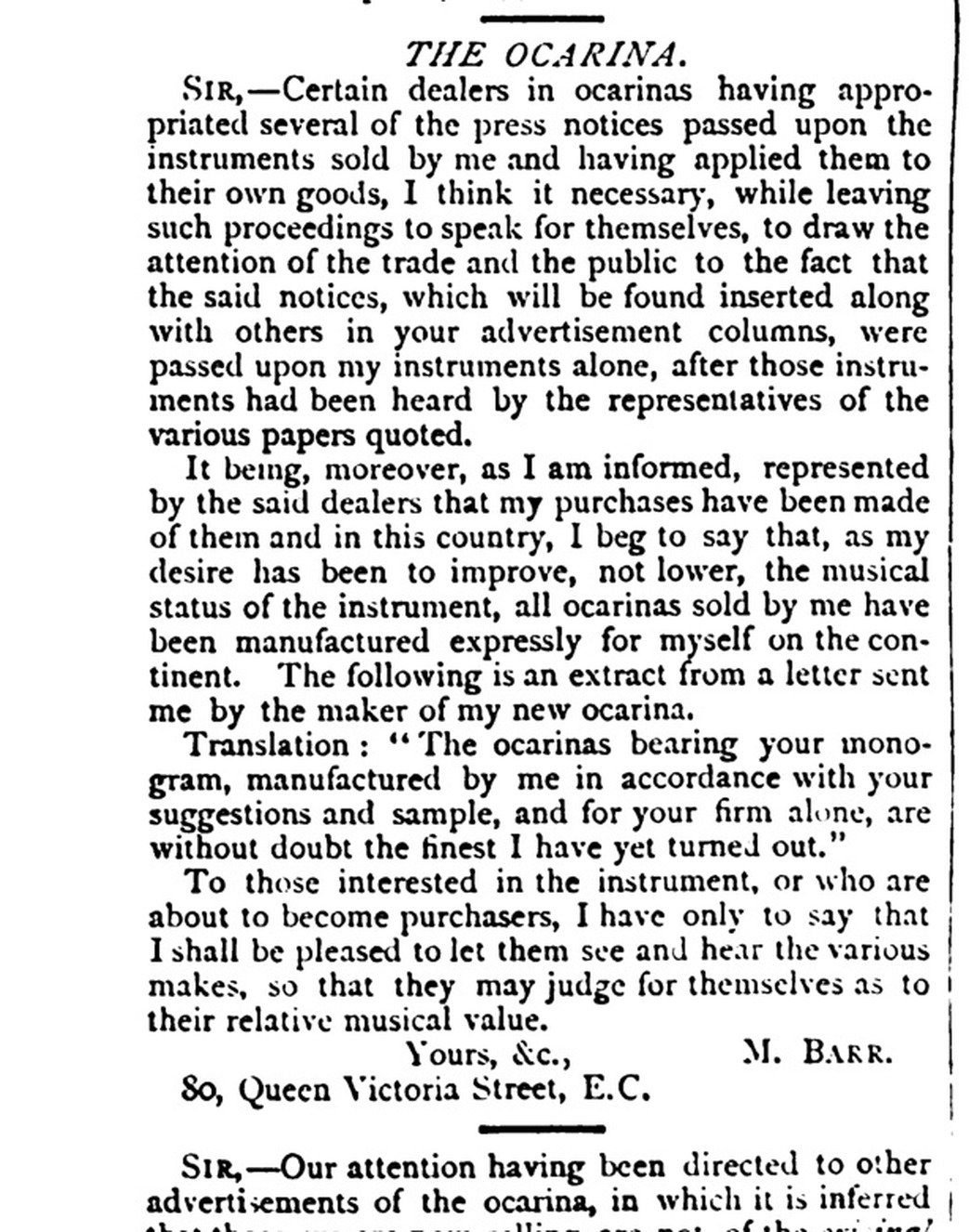
THE OCARINA.
Sir,—Certain dealers in ocarinas having appropriated several of the press notices passed upon the instruments sold by me and having applied them to their own goods, I think it necessary, while leaving such proceedings to speak for themselves, to draw the attention of the trade and the public to the fact that the said notices, which will be found inserted along with others in your advertisement columns, were passed upon my instruments alone, after those instruments had been heard by the representatives of the various papers quoted.
It being, moreover, as I am informed, represented by the said dealers that my purchases have been made of them and in this country, I beg to say that, as my desire has been to improve, not lower, the musical status of the instrument, all ocarinas sold by me have been manufactured expressly for myself on the continent. The following is an extract from a letter sent me by the maker of my new ocarina.
Translation : “The ocarinas bearing your monogram, manufactured by me in accordance with your suggestions and sample, and for your firm alone, are without doubt the finest I have yet turned out.”
To those interested in the instrument, or who are about to become purchasers, I have only to say that I shall be pleased to let them see and hear the various makes, so that they may judge for themselves as to their relative musical value.
Yours, &c., M. Barr, 80, Queen Victoria Street, E.C.
Barr’s letter is in English throughout. The “Translation” belongs to the sentence before it: his maker’s letter arrived in another language, and this is the English of it. Which language, neither Barr nor the paper says — and that one printed word is the whole evidence that the maker was not English.
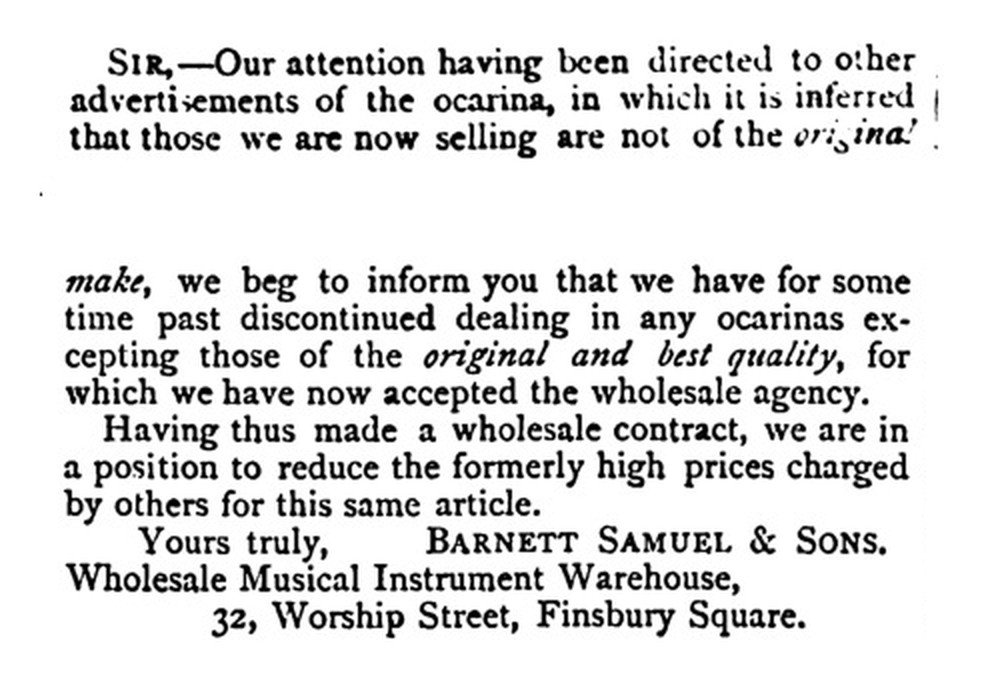
Sir,—Our attention having been directed to other advertisements of the ocarina, in which it is inferred that those we are now selling are not of the original make, we beg to inform you that we have for some time past discontinued dealing in any ocarinas excepting those of the original and best quality, for which we have now accepted the wholesale agency. Having thus made a wholesale contract, we are in a position to reduce the formerly high prices charged by others for this same article.
Yours truly, Barnett Samuel & Sons, Wholesale Musical Instrument Warehouse, 32, Worship Street, Finsbury Square.
What Barr’s letter establishes, on his own word: his ocarinas were made for him on the Continent; the maker wrote in a language needing “Translation”; the instruments were made for his firm alone, to his suggestions and a sample; and they carried Barr’s monogram, not the maker’s. He also says “my new ocarina” and “the various makes” — he had lately changed suppliers.
What the reply establishes: Barnett Samuel had taken the wholesale agency for what it calls the original make, and the point of saying so is the sentence that follows — it can now undercut “the formerly high prices charged by others”. In January it advertised as “the Manufacturers”; by April it is the agent for somebody else’s manufacture, which is a different claim about the same goods.
The argument is about authenticity and the stake is price, and the January column shows the gap the letters are fighting over: 1s. to 2s. against 2s. to 8s.
Who Barr’s maker was, the museum does not know. The letter quotes him and does not name him.
Barr himself, and a portrait the museum has not seen
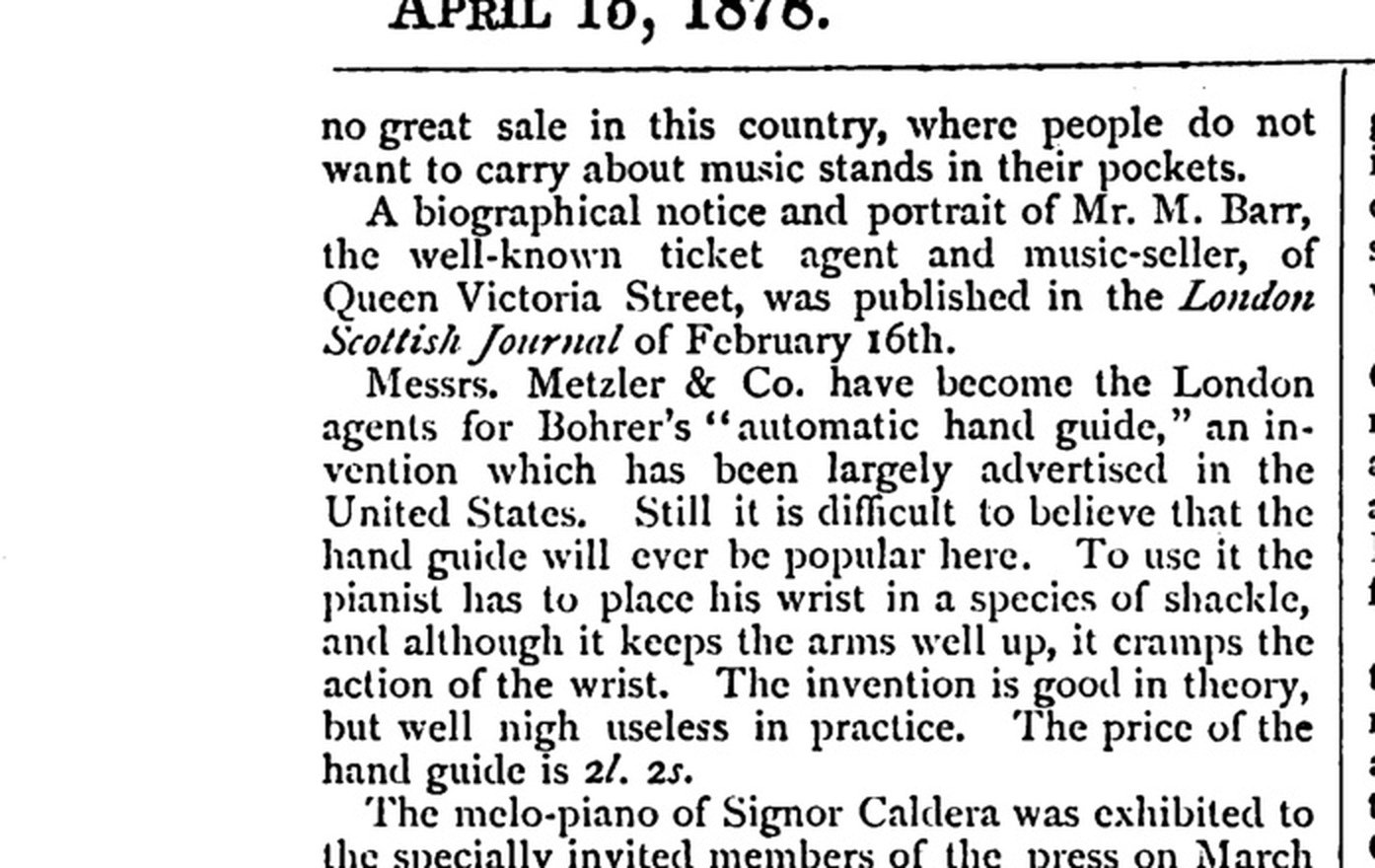
A biographical notice and portrait of Mr. M. Barr, the well-known ticket agent and music-seller, of Queen Victoria Street, was published in the London Scottish Journal of February 16th.
The first independent statement of what Barr actually did: a ticket agent and music-seller — a retailer, not a maker — already well-known in April 1878, before the quarrel that made him visible to this project.
March 15, 1880 — the paper says it is over
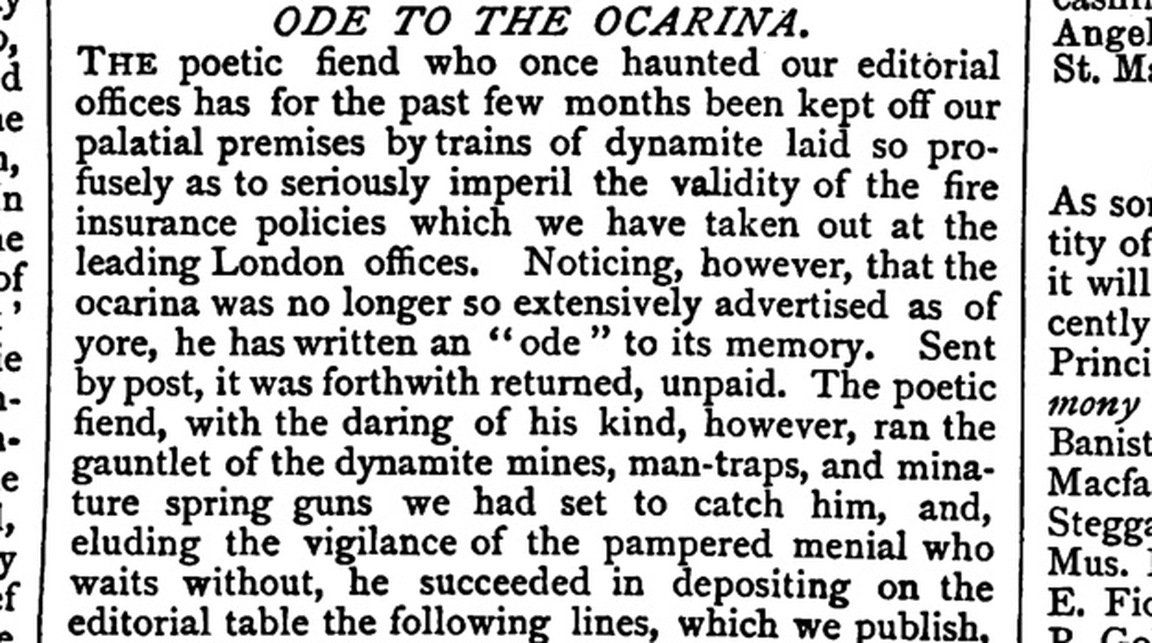
ODE TO THE OCARINA. The poetic fiend who once haunted our editorial offices has for the past few months been kept off our palatial premises by trains of dynamite… Noticing, however, that the ocarina was no longer so extensively advertised as of yore, he has written an “ode” to its memory.
A joke about a dead fashion, and a dated editorial statement that London advertising had fallen away by March 1880.
But the poem is not London’s. The Music Trade Review of New York had printed it eight months earlier, on July 12, 1879. The two texts run together for twenty lines and part at four points of substance, every one a localization — and at a fifth that is not: New York’s “the earthen ocarina” is “the earthern ocarina” in London, a slip rather than a change. They also close differently. London ends “But you’re not one, my ocarina!”; New York ends the same words with a question mark.
| New York, July 12, 1879 | London, March 15, 1880 |
|---|---|
| Poets love the blue bird’s twitter | the young bird’s twitter |
| Dutchmen twang the wiry zither | Germans twang the wiry zither |
| buzzing like the Jersey skeeter | buzzing like the walking skeeter |
| Dear is Hayes to C. A. Dana | Dear is Barr to Barnett Samvel |
The last of those is the interesting one. New York’s line is an American political joke — President Hayes and Charles A. Dana of the New York Sun, who loathed him. London struck it out and put in the two dealers who had been at war in that paper’s own correspondence columns the year before, spelling the name Samvel for the joke. Both versions end on the same couplet — “Fools applaud a well-puffed fraud, / But you’re not one, my ocarina!” — which, after a year of rival advertisements each claiming the original ocarina, reads in London as a verdict on the quarrel.
So the paper’s story about a “poetic fiend” leaving the lines on the editor’s desk is a fiction wrapped round a borrowed and rewritten squib. Somebody in that office knew the dispute well enough to aim it.
What this does and does not change. The sentence the dating rests on — “the ocarina was no longer so extensively advertised as of yore” — is the London editor’s own prose about London advertising, and it stands. The verse is not evidence of anything British; it is an American joke with four words changed.
The poem itself is not reproduced here. Its first line, identical in both papers, carries a racial slur in the ordinary printed usage of 1879. What is quoted above is the editor’s prose and the four substituted lines.
It is not being withheld, and this page is not the only way to it. Both papers are long out of copyright and HathiTrust serves both in full view. The New York printing is image 219 of nyp.33433085184152; the London one is image 65 of nyp.33433074758081. Open either volume and search it for ocarina — see Where these pages are — and anyone who wants to check the collation above can read both.
Why this is a decision and not an oversight. The museum’s standing rule is that a source is reproduced as printed, and corrected beside it rather than inside it. That rule exists to stop the museum improving other people’s words, and it was written for makers’ spellings and interviewees’ grammar. Whether a slur in an 1879 trade weekly is set in type on a museum page is a different question, and it is left open here rather than settled by default in either direction.
1888 and 1889 — the afterlife
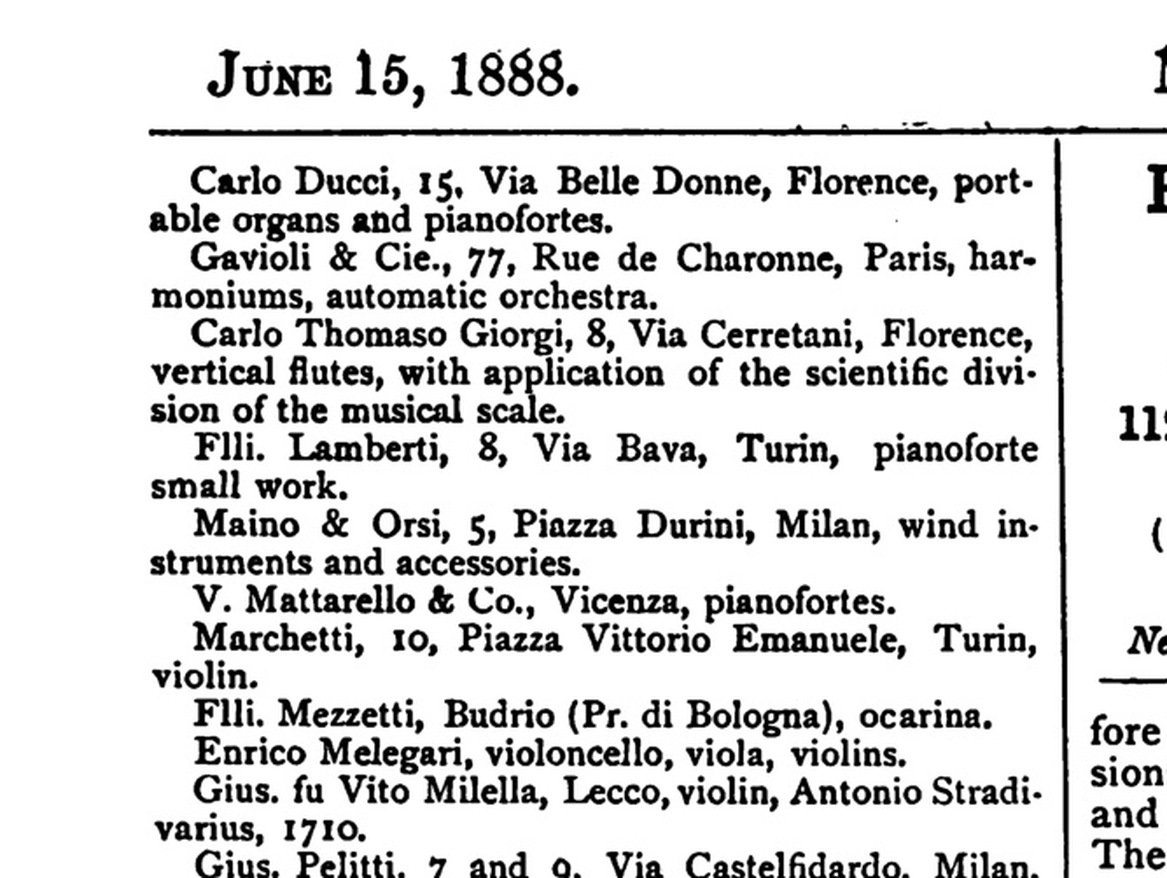
Flli. Mezzetti, Budrio (Pr. di Bologna), ocarina.
Flli. is Fratelli — the Mezzetti brothers, in Budrio, under a firm name, in their own province. The museum’s patent filings for this family are Alberto Napoleone’s, from Paris and London. This is the firm at home.
The following year the instrument appears once more, among mechanical organs, a musical box playing thirty-six airs, and a singing bird in a gilt cage:
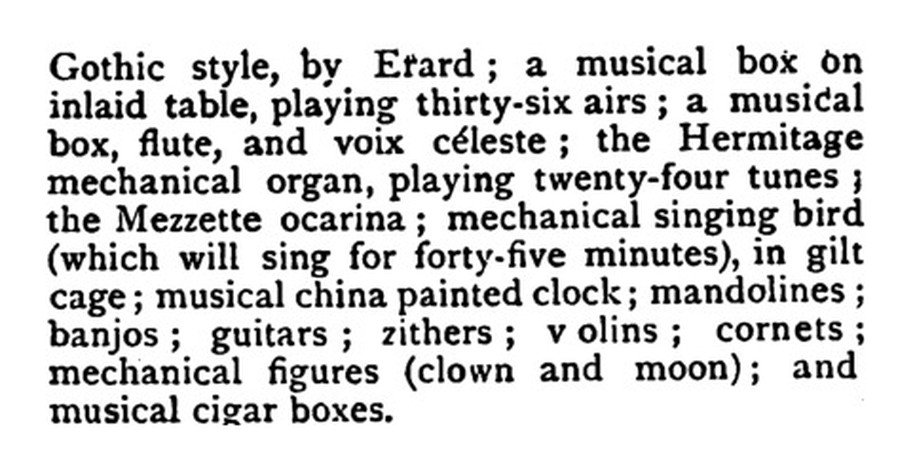
…the Hermitage mechanical organ, playing twenty-four tunes; the Mezzette ocarina; mechanical singing bird (which will sing for forty-five minutes), in gilt cage…
A curiosity in a list of curiosities — and the name mangled a fourth way, after Metzculini at Melbourne in 1880, Mezzotti at London in 1885, and Bezzetti in a Spanish catalog of 2024.
What can be speculated
Everything above this line is quoted. Everything below it is not.
The shape of the run looks like a craze. Two years of saturation, a third in which the paper says it is finished, then four of the next seven years returning nothing and three of them volumes HathiTrust does not hold, and two mentions in which the ocarina is no longer news in its own right — a firm’s name in a list of exhibitors, and an oddity in a column of curiosities. The museum cannot say from a trade paper how many people played the ocarina — only how hard it was being sold.
The patents cluster where the selling does, and now so does the selling. Barr had the instrument on sale in London in December 1877, the same month Fiehn filed in France. Fiehn filed in France, Belgium, and Britain between December 1877 and April 1878; Mezzetti filed in France and Britain in the spring of 1878. After that burst the museum’s patent register is empty for three years — the next ocarina filing in it is Fiehn’s German patent of 1881, and the next after that Mezzetti’s of 1885. Makers patent when they think there is a market to protect, and this paper shows the market in exactly the months the filings fall in.
Passage Jouffroy runs directly on from passage Verdeau, divided by one street. The French patent of 1877 — three applicants, filed in their own names with no agent named — was filed from passage Verdeau. Within the year a company to sell ocarinas opened a two-minute walk away. That is proximity, not a connection. The paper names nobody, and an arcade is a row of shops.
Barr’s quarrel reads differently once 1878 is in view. It is not two dealers falling out over a novelty; it is the second year of a trade that already had a Paris company, four patents and a London agent behind it.
What is still missing
The full specifications behind the two British numbers. The Patent Office’s Abridgments of Specifications for music, 1877–1883, prints a summary of each, and marks GB 1,605 “[Provisional protection only.]”. The specifications themselves are at the British Library or the IPO.
The Belgian document. BE 44,804 names its own parent — the French patent of December 18, 1877, which the museum holds and has read — so its content is probably already in hand.
Barr’s portrait, in the London Scottish Journal of February 16, 1878. Nothing in this project holds an image of any of these people, and the notice may name his suppliers.
Six years HathiTrust does not have. Its public-domain run of this paper — read from the library’s own catalog record, which lists every volume it holds — is missing 1882, 1884, 1885, 1890, 1891, and 1893. Three of those six are the ones the museum would most like to read: 1882 for a number it has never been able to place, 1885 for Mezzetti’s double-octave concert ocarina, 1891 for three French filings in a single year. Another holding library would settle them.
The rest of both volumes. Twenty pages of 1878 and twenty of 1879 were saved, chosen by searching for one word. The volumes run past three hundred pages each.
Where these pages are
Every quotation and every page image above comes from HathiTrust, which serves all of these volumes in full view — they are long out of copyright. The museum holds its own copies, downloaded a page at a time, because the library refuses automated requests.
| volume | HathiTrust identifier |
|---|---|
| Music Trades Review, London — catalog record 103045022 | |
| 1877–1878 — the volume is cataloged v. 1–14 (1877–1878) | nyp.33433074758065 |
| 1879 | nyp.33433074758073 |
| 1880 | nyp.33433074758081 |
| 1888 | nyp.33433074758164 |
| 1889 | nyp.33433074758172 |
| The Music Trade Review, New York, 1879 — catalog record 103061383 | nyp.33433085184152 |
Two things the catalog gets wrong, recorded here rather than silently corrected. The New York record is titled The Musical and dramatic times and music trade review, an earlier title of the paper; the running head on every leaf held reads The Music Trade Review. And that record dates the item held here to 1876, while the four leaves are dated May 17, July 6, July 12, and August 2, 1879 on their own running heads. The pages are the evidence and the catalog label is not, so the museum dates them 1879 and says so here.
To reach a particular page, use the reader’s own search. Open the volume and type ocarina into Search in This Text, in the panel on the left; it lists every page in that volume carrying the word, and one click goes to it. That is how all of this was found, and it is the reliable route — appending &seq= to the link is possible but does not always land where you expect.
The image numbers are for citing, not for navigating. Every figure above carries its issue and its image number, and every passage quoted in “What the papers say” has its page image beside it. Those numbers are HathiTrust’s scan sequence, not the printed page: these volumes restart their pagination with every issue, so the printed number on the leaf identifies nothing on its own.