A History of the Ocarina
The ocarina from the Xun to the English four-hole, written by the makers who originated the latter.
A note from the museum
This note is written by The Ocarina Museum, not by the authors of the article. Baz Jennings’s history itself begins below it.
The history was written for Ocarina Originators — the project of Barry “Baz” Jennings (1940–2004) and John Taylor, who originated the English four-hole ocarina — and published on ocarina.demon.co.uk, circa 1997–2001. The site’s copyright notice names Ocarina Originators; the writing is most likely Baz’s. Read the archived original.
Ocarina Originators’ own terms reserved all rights and asked that nothing be copied without written permission. That permission can no longer be given to anybody. Barry Jennings died on August 28, 2004 and John Taylor on February 20, 2011. Baz left no children and no relative or heir has been found — asked in September 2026, Sandi Schmidt, wife of Richard Schmidt (see below), said she knows of none.
Before he died, Baz asked that the site be kept alive. Richard Schmidt of ClayZeness Whistleworks in Seattle took that on and mirrored it; a second copy was kept at pollardhosting.com. Richard died on November 29, 2013, clayz.com has since lapsed, and the pollardhosting copy has vanished without trace. Two of the three custodial copies are already gone, and what follows is, so far as can be established, the most complete copy of this history that survives anywhere.
The museum publishes it on that basis and states the position plainly: without a license it was unable to obtain, without commercial use, with its authors named, and with an undertaking to take it down at once should anyone entitled to ask ever wish it.
The ceramic Ocarina is probably more than 12000 years old. Ancient examples have been cited -small whistles shaped like birds or other animals and made of terracotta are known in India for 6,000 years. China has a very long history of music- songs and dance had already appeared as early as five thousand years ago.
Among the archeological relics, there is an egg shaped wind instrument- the Xun, made of earthenware clay with six tone holes and a blowing (embouchure) opening in it. The Xun has a history of more than 7000 years.
At various times in Chinese history, musical culture is known to have been flourishing. In the Zhou Dynasty (-256.B.C) there already appeared large-scale a orchestra in the imperial court. Musical culture in the Tang dynasty (618-907A.D) was so developed that it ranked among the best in the world and exerted great influence on the development of music in the countries in Southeast Asia.
Although Europeans may have seen and heard of the Chinese Xun -“tschuan” or “tsing” all of 700 years ago,The sound and manner of playing was unknown in Europe. The same was true for the ancient Indian versions.
Many native American makers sculpted various forms of zoomorphic (animals, reptiles or birds) and anthromorphic (human) shapes for their fifes, trumpets, whistles and ocarinas.
Through the development of ritual, early culture produced “dancers’ whistles”-the first ceramic fippled instruments1-leading to ocarinas and double-chambered whistling vessels.
These were native to the cultures in Central and South America in a society so distinct from other world cultures of the time, although similar in that music had grown from both physical and ritual roots.
Of the Maya, Aztec and Inca peoples it was the Aztecs who brought the ocarina to Europe-though it is unlikely the Aztecs posessed any of the superior Mayan type.
Exterior Link-Aztec Music Essay
The Aztecs in Europe, 1527
Cortes sent a large party of Aztec dancers and musicians to emperor Charles V to demonstrate the nature of Charles’ new subjects from the New World.
In 1527 their performance for the court at Valladolid astounded everyone-a combination of ‘X-files’ and Busby Berkley-before a people with a very different tradition who were impressed with the power of the alien music to influence their mood and emotions- even more than the vast collection of looted treasure that had so impressed Albrect Durer when it was exhibited in Brussels seven years earlier.
The Aztec singing was in perfect harmony, the huge flowing ensemble of dancers moved in virtually absolute synchronicity. Their visit also impressed other Europeans with the power and wealth of Spain-at the same time as impressing the priestly class of Aztecs of the futility of opposing their conquerors.
The Aztec musicians had ocarinas with them -descendants of fippled pottery whistles and vessel instruments with mouthpieces which had been developed millenia previously by the “alti-plano bird dancers”.2
They became famous and were sent to perform a series of exhibitions all around Europe after they were first seen in Rome by Clement VII.
The Aztec tour made a deep impression on European musical development: To this day there is a tradition of pan-pipe ensembles in Northern Italy.
From toy to instrument
One scenario runs that a baker in a noble Roman household was so impressed by the sound and sight of the Aztec clay instrument, that he immediately made some clay whistles of his own-it was common at the time to utilise the hot ashes of the bakers’ ovens to make low fired pottery items-mostly toys-and the novelty swept into fashion among bakers all over Europe and were an amusing new toy -the word ‘ocarina’ means ‘little goose’ in the Italian Emilian dialect.
It is possible that ‘little goose’ has some connection with the affectionate mockery of children-or even it’s sound. There seems no obvious connection with it’s shape.
These sweet sounding toys sold at Markets and Fayres spreading to other makers throughout Europe.
The ocarinas remained a popular toy for more than 340 years until a 17 year old Musician-Baker, Guiseppe Donati, of Budrio (near Bologna) Italy, transformed them (local tradition says that it was as a joke to amuse his friends) from a toy which only played a few notes, into a real instrument which could play more than an octave accurately: Donati originated the first pitched diatonic scale ocarinas.
The Budrio makers
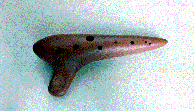
Other makers too, developed consorts of ocarinas in eleven different sizes for group and solo concert performance. Various tutors were published and the ocarina became an ‘instrument of the people’.
In 1870 two ocarina ex-apprentices, ex-members of the Budrio ocarina ensemble, Ercole and Alberto Mezzetti began to make ocarinas in Paris. Their ocarinas won many important prizes in Paris and Edinburgh and other exhibitions.
Another maker was Luigi Silvestri. from Camisano Vicentino who invented the double ocarina, and his ocarinas were sold all over the world.
In 1874, a journalist wrote of an ocarina concert at the Crystal Palace in “The London Daily News” that the ‘Mountaineers of the Apennines’ ocarina consort ‘played a selection of operatic morceaux with a perfect skill and execution’.
The consort included Cesare Vicinelli, one of Budrio’s famous ocarina maker/players and the brothers Ercole and Alberto Mezzetti. Alberto settled in England giving concerts to play and promote ocarinas produced at Ercole’s Paris workshop and importing his brother’s products from France, published ocarina tutors to spread ocarina playing in Britain.
The first maker of ocarinas, Giuseppe Donati, won a gold medal at the Bordeaux exhibition of 1875 and later he received a diploma of honour.
He signed his ocarinas in gold.
In one of his catalogues published in Milan we find the several types of the ‘real ocarinas of Budrio’. in the keys “do Piccolo, Si, La, Sol, Fa, Mi, Re and Do Basso”; “ocarinas in terracotta, black ebony (deluxe with golden finish and box in china) in aluminium; and the latest types: pump ocarinas, flute ocarinas, double ocarinas (with 2 octaves), ‘bottle’ ocarinas and three voice ocarinas”.
Donati always stated in his catalogues, stationary and letters that his ocarinas were ‘entirely hand-crafted’ without ‘the aid of any machinery’.
Vicinelli, Canella and the next generation
In 1878, when Giuseppe Donati had a workshop in Bologna, Cesare Vicinelli began to make ocarinas at a place not far from Budrio known as “Fornace Silvani” [“The Silvani Kiln”]. His father had been a baker and he was an experienced baker himself, Cesare’s expertise as a kilnman and as a multi-instrument musician placed him in an excellent position to become an ocarina maker and player. He accordingly invented proper moulds, which vastly increased his output.
Antonio Canella was making ocarinas in Ferrara from about 1878 to 1940. Like Donati he made various types; double ocarinas (one above the other), with a metal piston to alter pitch, etc. He made up to 100 ocarinas daily and exported them far and wide. He also made artistic ocarinas for special commissions.
C. Mathieu was making ocarinas in ‘fin de seicle’ Paris - he patented a metal ocarina shaped like a bird, mounted on a metal support, that stood more than one metre high.
A ‘Compagnie Generale de L’Ocarina’ was formed to promote ocarina playing in France. In Pistoia. G. Boscherini, in Milan. Ghezzi, Epaminonda Bezzi in Ravenna, in Vienna, H.Viehn, and other makers in Italy and the rest of the world were beginning, or in, full production.
Ottorino Respighi Antonio Certani Ligeti, Penderecki and Janacek are only a few of the Composers who wrote parts for ocarina in their orchestral works.
When Cesare Vicinelli died in 1920 Guido Chiesa, his assistant for twenty-four years, was heir to his studio, his tools, his house and his tradition.
Chiesa was then thirty-six, having been born into a market-gardening family in 1884. Vincinelli had not been too keen to teach the subtle secrets of fine ocarina making to his erstwhile apprentice who had to shine for the honour of the Sylvani studio and the Budrio tradition.
Cesari, the wars, and Mignani
Another luminary of Budrio, Emilio Cesari, was a contemporary of Chiesa.
While a student at the Bologna Conservatorio, he had worked for Cesare Vicinelli.
Cesari manufactured the ‘Ocarinton’, an ocarina with 2 pistons to change key, invented by Canella, and a 2-octave ocarina-“Flautino”. (Luigi Silvestri had originated a double ocarina, with two octaves, with a smaller ocarina inside a bigger one; the model then inspired Antonio Canella to originate a “Bi-ocarina”, made of two ocarinas, one above the other with two mouthpieces close together, and from it Emilio Cesari. developed the triple ocarina.)
He also wrote a tutor and composed several pieces for both solo and group playing. His studio was in a place near Budrio called “Le Creti” for seven years from 1920-27 when he removed (aged 39) to S.Remo via Bologna for his last performance as conductor and player of the “Gruppo Ocarinistico Budriese”. He then discontinued ocarina making becoming a member of S.Remo’s “Orchestre di Casino”
Luigi Avalli from Cremona (1840-1917), created a double voice ocarinas in ‘Terre’ (1/3) and ‘Gemelle’ (1/1) that were much prized abroad, especially in Germany. He won several local prizes.
Servicemen in WW1 Europe had moulded plaster or metal ocarinas (made by H.Viehn or C. Mathieu among others) to lift their morale as much as could be expected.
Japanese sculptor Aketa began ocarina making in 1928.
In S.Remo in 1940 Cesari began to produce ocarinas again and gained distinction and recognition.
American servicemen brought bakelite (first moulded plastic) versions to Europe during the Second World War.
They were made by Gretch and issued together with special military ocarina tutor books. The same ocarinas were sold by mail from Sears Roebuck after the war.
Bing Crosby used “the little ocarina song” in “The Road To Bali”.
In 1963 Arrigo Mignani, who had been a member of the “Gruppo Ocarinistico Budriese” got in touch with Chiesa and made a proposal for both his knowledge and his business-Chiesa had done well, he was probably ready to retire. Unfortunately, the grand old Chiesa at eighty wanted twenty million lira- a figure which stunned Mignani. Mignani eventually produced his first complete range of ocarinas a year later with tools he obtained for a mere million from the heirs of Emilio Cesari.
John Taylor and the English ocarina
In London England, John Taylor who had started making ocarinas in 1963 after seeing ancient pottery instruments in the British Museum, made the first “English Style” four-hole (proportionally tuned) ocarina in year of dragon 1964.3
Makers inspired often by him or his friends all round the world experimented during the 1960’s and 1970’s to find their individual expression in various forms of ocarina.
There have always been special types of Ocarinas because the inventor and maker always tries to explore the possibilities of the instrument.
The best Ocarinas are those made by artisans; the original inventors and the first craftsmen have always made them exclusively by hand.
To make them one does not need any particular specialist tool but only a good musical ear, the ability to do concentrated but relaxed work consistently and to make ‘concert’, because to craft several ocarinas perfectly in tune is full of nicities.
— Guiseppe Donati
Instruments appeared in various geometric forms and in the shape of birds, dolphins, hamadryads,4 bats, turtles and dinosaurs- etcetera. Various doubles, triples, chord pipes and experimental, and an ocarina to be played by 4 people (square torus with 4 mouthpieces)5
“Wild Thing” catapaulted the ocarina of Reg Presley to fame with the “Troggs” and in 1976 Berthold Bertolucci’s film opus “1900” displayed the traditional Italian ocarina sound to marvellous effect.
A huge range of unique single and multiple ocarinas made by John Taylor’s circle were sold at Portobello Road and Hampstead (seasonal Sunday craft market), Camden Passage and Camden Lock Market, Petticoat Lane, Green Park/Hyde Park (Sundays) Piccadilly (StJame’s) and at many of the British festivals of the 60s and 70s and 80s by Linda Guscott, Malcome Hawley, Flora Cormack, Michael Cardew, Paul Bandy, Barry Jennings, Judith Pertz and especially by John Taylor himself.
Other makers in the circle included the poet John Tungay and sax-player Lyn Dobson.
Other apostles before 1970 included an Australian (who took the craft back to Oz), an American artist Susan Rawcliffe [in 1969] and European travellers. Some of John’s original circle continue to make ocarinas and pass on the craft to others.
In Japan, the traditional style has grown and flourished attaining every bit as much popular appeal as in Europe and the USA and even cult status with virtuoso Sojiro’s many concerts and recordings.
Ennio Morricone’s featuring of the ocarina in “The Good, The Bad and The Ugly”-and other film scores -and Simon Le Bon of Duran Duran have both exploited the ancient pure tones of this simple yet subtle instrument.
In addition,the activities of JT and friends has influenced widely in Britain, USA and in Europe the diversification of ocarina production.
Until about 30 years ago, ocarinas required a skilful and practised technique: but now thanks to a special tuning originated by John Taylor and developed variously by Barry Jennings and John Taylor, they are very easy to play and need only seven or eight holes to perform all that an eleven or twelve hole Traditional ocarina can and more (glissandos and rapid trills).
They are availiable with the “Firebird”™ “Equal Breath Voicing”™.
They have individual tones, a wide dynamic range and can be far smaller than the traditional elongated egg shape.
TO BE CONTINUED
The Wind Jewel
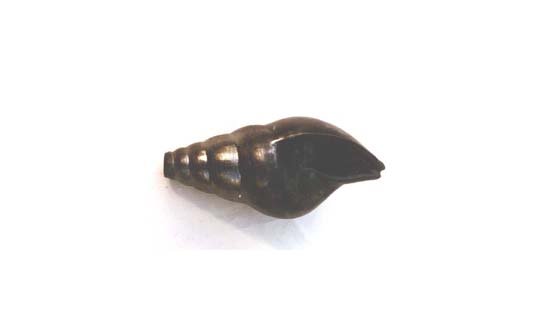
“Wind Jewel” the name for our ocarina Music information project-the origin of the name is a New World one- the spiral shape of the “Wind Jewel” is inspired by the Aztec symbol for the conch shell-one cut through to reveal the interior spiral was worn ceremonially by the priests of “The Lord of the Winds”. Complete conches were used as a trumpets in Aztec ceremonial musical ensembles.
The spiral shape can be found everywhere in Nature: the little spirals emanating from the main helix of the “Wind Jewel” Mark are reminiscent of fractals and the Fibonacci Series which is a mathematical model of the proportions of a spiral, named after Fibonacci (Mathematician of Pisa circa 800 years ago).
There is also a connection to a natural series throughout the permutations of proportional fingering. For another commentary relevant to the history of ocarina crafting: Ocarina and other Histories: Alan Albright
Giuseppe Donati
Donati was only seventeen when he invented the ocarina-(according to the only known interview)- in 1853. He was born on the 2nd of December 1836 at 2am to Giuseppina Cavazza, second wife of Giovanni Battista Donati. Their child was baptised in the St. Lorenzo of Budrio church with the name Giuseppe Luigi.
He was the thirteenth child to be born in the Donati family, and after a little time at school he had to start work as a baker to help the family.
He was a musician who played the clarinet, the piano and the organ in his free time. Probably his first idea was to increase the number of holes in ocarinas (shaped like an egg and made of terracotta, that were traditionally sold in markets) so that he could play an octave.
The local legend has it that his first attempt was made as a joke, but he got fascinated with the craft he was pioneering, so he persevered: he attempted to make a terracotta trumpet but it was too long and broke, so he concentrated on a stronger shape, the ocarina, which with eleven holes, arranged the best position for fingering, allowed the playing of complex tunes with more range than those he could play with the prototype instruments he began with.
With ocarinas of various dimensions he got specific keys.
The first ocarina group, called ‘Concerto Delle Ocarine’ was formed in 1863, Founded by Donati himself, they had immediate success in fairs, in tavernas, in the theatre and in all sorts of public events.
The demands for ocarinas were increasing, not just among children- even musicians were attracted to them, and the more successful the quintet became, the bigger the demand.
Donati himself started selling his ocarinas in markets and fairs in his region.
He married in 1866 and started to run a cafe-patisserie making ocarinas in his new workshop out of hours.
He was so absorbed in work that he could not allocate any time to musical composition
In 1878 he moved to Bologna where his business would expand and allow him to quit other work.
He opened a branch in Milan In 1904 and in 1907 he moved there.
The competition with the new makers of ocarinas (Cesare Vicinelli in Budrio, Antonio Canella in Ferrara) was beginning to be felt.
In Milan Otello Cavara interviews him, and he finds him somewhat depressed. He has been evicted because the house has to be demolished and it is difficult to find a new home with another kiln for the ocarinas.
He is still a kind and acomplished man, very active regardless of his age. He is 74 years; an almost charismatic figure, like a sage on some great mission, “with a great dressing robe, wrapped around his tall and bony body, with a cap on his head, and his lively face framed by the whiteness of his hair and flowing beard”.
During some unfortunate episodes he had virtually become insolvent, but more than necessities, it is dedication that pushes him to excel, to make his ocarinas with his own hands, in terracotta or aluminium, always creating anew, composing appropriate music, and transposing from opera to assemble a repertoire that, with his own practical playing tutor for ocarina, he sold to an ever increasing clientelle.
All this eventually became too much to handle alone.
The death of his wife made his final years more and more sad and lonely.
He died at the age of 88 on the 14th February 1925. His sons did not begin in their father’s business, choosing better paid employment.
But everybody that knew him remembers his goodness.
The town of Budrio, to honour the memory of his work, dedicated a street to his name in 1945 and in 1963 promoted some public celebrations to mark the centenary of the local ocarina band.
How this copy was made
This copy was made on April 24–25, 2023 from the Internet Archive’s captures of ocarina.demon.co.uk, made between September 2001 and February 2002. The site’s eight history pages were saved in turn, along with its separate biography of Giuseppe Donati; the original and archived address of every one is listed below.
It was taken from Baz’s own site rather than from Richard Schmidt’s later mirror, and the two are not identical. The mirror spells Daniel Statnekov’s name “Statnikov” and relabels the site’s outbound links, where this copy keeps Baz’s own wording; the mirror also carried a 2003 revision, while this is the version bearing “© Ocarina Originators 1997 and 2001”.
A note on the text
The wording is the authors’ throughout, including its spellings. Only run-together words introduced when the pages were saved have been repaired: “Camisano Vicentinowho”, “Fibonacci Serieswhich”, “invarious”, “H.Viehnor”, “JTand BJ”, “tutor books.The same”, and the trademark marks written “TM” in the saved text are set as ™. The page breaks of the original eight-page site have been replaced with section headings; a paragraph on Taylor’s tuning that fell below the footnotes on the seventh page has been returned to the passage it belongs to; and a quotation from Giuseppe Donati, which the original fenced between horizontal rules, is set as a quotation. Nothing has been added to the authors’ text and nothing removed from it: the words here were checked against the saved copy one by one.
Four slips are the authors’ own and are left as written: Berthold Bertolucci (the director of 1900 was Bernardo), Albrect Durer (Albrecht Dürer), Gretch (the American maker was Gretsch), and a footnote glossing hamadryad as “a mythic creature like an owl” (a hamadryad is a tree nymph, or a king cobra). Guiseppe and Giuseppe alternate in the original.
“YJ” in the Aztec footnote is unidentified; “JT” and “BJ” are John Taylor and Barry “Baz” Jennings.
Source pages
Saved from the Internet Archive. The original site was eight linked pages plus a biography of Donati.
- hist.html · archived
- hist1.html · archived
- hist2.html · archived
- hist3.html · archived
- hist4.html · archived
- hist5.html · archived
- hist6.html · archived
- hist7.html · archived
- Don.html · archived
Rights statement: copy.html — “All rights in such material are reserved to Ocarina Originators. and materials may not be reused in any way or copied in whole or part without prior written permission from Ocarina Originators”.
More about Ocarina Originators, and what the museum holds of it.
If you wrote this, or were interviewed in it, and would like it changed or removed, please write to theocarinamuseum@gmail.com.