Exhibition Catalogs, 1869–1900
The source class that reaches where the patent record cannot
Official catalogs, exhibitor lists, and jury reports from the great nineteenth-century exhibitions: Fiehn at Sydney and Melbourne, a Melbourne jury of 1880 that says he brought “Metzculini’s invention” into Germany, Mezzetti and Fiehn at London in 1885, two Vienna makers in 1888, and three catalogs in which no ocarina appears.
Every claim below names the document it came from, and every page image is reproduced from a scan the museum holds. Where a source is mangled, damaged, or silent, the page says so rather than smoothing it over. Research and drafting were done with help from Claude, Anthropic’s AI assistant.
Giuseppe Donati invented the modern ocarina at Budrio, in the province of Bologna, in 1853. Patents record part of what followed: from the late 1870s, Fiehn, Mezzetti, and others filed for ocarinas in Austria, France, Belgium, Britain, and Germany, and the museum’s patents page gathers those filings. A patent records an invention and who claimed it, and some patents say the claimant made ocarinas. What a patent does not record is what makers showed the public.
Exhibition records do. The great exhibitions published official catalogs, exhibitor lists, and jury reports, printed in large runs and long out of copyright, and libraries have digitized many of them. Their most useful fact is the year: an exhibition entry shows who was active when. The next is the place, because where the instrument was shown measures how far it had reached. A catalog whose musical instrument section is complete can also show that no ocarina was shown. Bologna in 1869 and Vienna in 1873, below, are two examples.
Dealers’ own catalogs answer a different question, what was stocked and offered, and a companion article, Trade Catalogs, 1878–1930, covers them.
What an exhibition catalog actually is
The phrase covers three different documents, and each proves something different:
| document | what it proves |
|---|---|
| Exhibitor list | that a named person put something on a stand, in a stated class, in a stated year |
| Jury report | what a panel of judges thought of it, in their own words |
| Award list | what, if anything, it won, and at what grade |
Many volumes print all three; some print only one. “Showed at Melbourne 1880” and “won at Melbourne 1880” are different claims, but the second implies the first. And a presence in a catalog is a date of exhibition, not a date of manufacture.
How the museum found these events
Heinrich Fiehn’s four-language method sheet — Schule für Fiehn-Ocarinas, printed by Lith. Stockinger & Morsack, Wien — carries in its margin, in small type outside the ruled box a player would read:

DÉCORATIONS: Linz und Ried 1877, Sydney 1879, Vienne 1880, Mention honorable, Melbourne 1880, II. Pr. Médailles d’argent. Teschen 1880, Frankfurt a/M. 1881, Egger 1881, Triest 1882, Amsterdam 1883, Vienne 1884, London 1884, Nice 1884, Anvers 1885, Vienne 1888.
Those are fourteen exhibitions between 1877 and 1888, named by the maker himself. Each one is a checkable claim.
Other events were found by following citations, where a patent examiner, a museum cataloger, or a rival maker names a catalog and a page; by reading the scans page by page rather than trusting a text search; and by checking claims that circulate without a source, which the museum treats as leads, not evidence.
What the museum has recovered
Each volume below has been searched and has a recorded verdict, including those that found nothing.
| event or volume | how held | result |
|---|---|---|
| Bologna provincial exposition, 1869 | PDF, 2 vols | clean negative |
| Vienna Weltausstellung, 1873 (instruments volume) | clean negative | |
| Philadelphia Centennial, 1876 | OCR, 4 vols | inconclusive |
| Sydney International Exhibition, 1879 | hit — Fiehn | |
| Melbourne International Exhibition, 1880–81 | hit — Fiehn, with jury report and award | |
| Patent- und Musterschutz-Ausstellung, Frankfurt, 1881 | page images and OCR | hit — Fiehn, twice |
| Gewerbe- und landwirthschaftliche Ausstellung, Eger, 1881 (prize list, Egerer Zeitung) | page image | hit — Fiehn, a diploma |
| Exposition internationale, coloniale et d’exportation, Amsterdam, 1883 | page image | hit — Fiehn and Kren |
| Exposition internationale de Nice, 1883–84 | page image | hit — Fiehn and Krenn |
| International Inventions Exhibition, London, 1885 | hit — Mezzetti and Fiehn | |
| Antwerp Universal Exposition, 1885 | page images | no conclusion: the wrong kind of volume |
| Antwerp Universal Exposition, 1885 (jury’s list of awards) | page images | hit — Fiehn and Kren, bronze-medal diplomas |
| Royal Jubilee Exhibition, Manchester, 1887 | OCR | no conclusion |
| Italian Exhibition, London, 1888 (award list) | page image | hit — Fratelli Mezzetti |
| Jubiläums-Gewerbe-Ausstellung, Vienna, 1888 | hit — Fiehn and Kren | |
| Exposition universelle, Paris, 1889 (jury report, Classe 13) | page image | hit — Mezzetti, mention honorable |
| World’s Columbian Exposition, Chicago, 1893 | page images | clean negative |
| Exposition universelle, Paris, 1900 (catalog and jury report) | PDF, two pages; page image | hit — Mezzetti, twice; the jury on Mezzetti, Fiehn, and Roda |
The exhibitions run from Bologna in 1869 to Paris in 1900.
What the documents say
Bologna, October 3–18, 1869 — no ocarina in the musical instruments class
Esposizione agraria ed industriale della provincia di Bologna nell’anno 1869, printed 1870. A provincial exposition in Budrio’s own province, sixteen years after Donati began working.
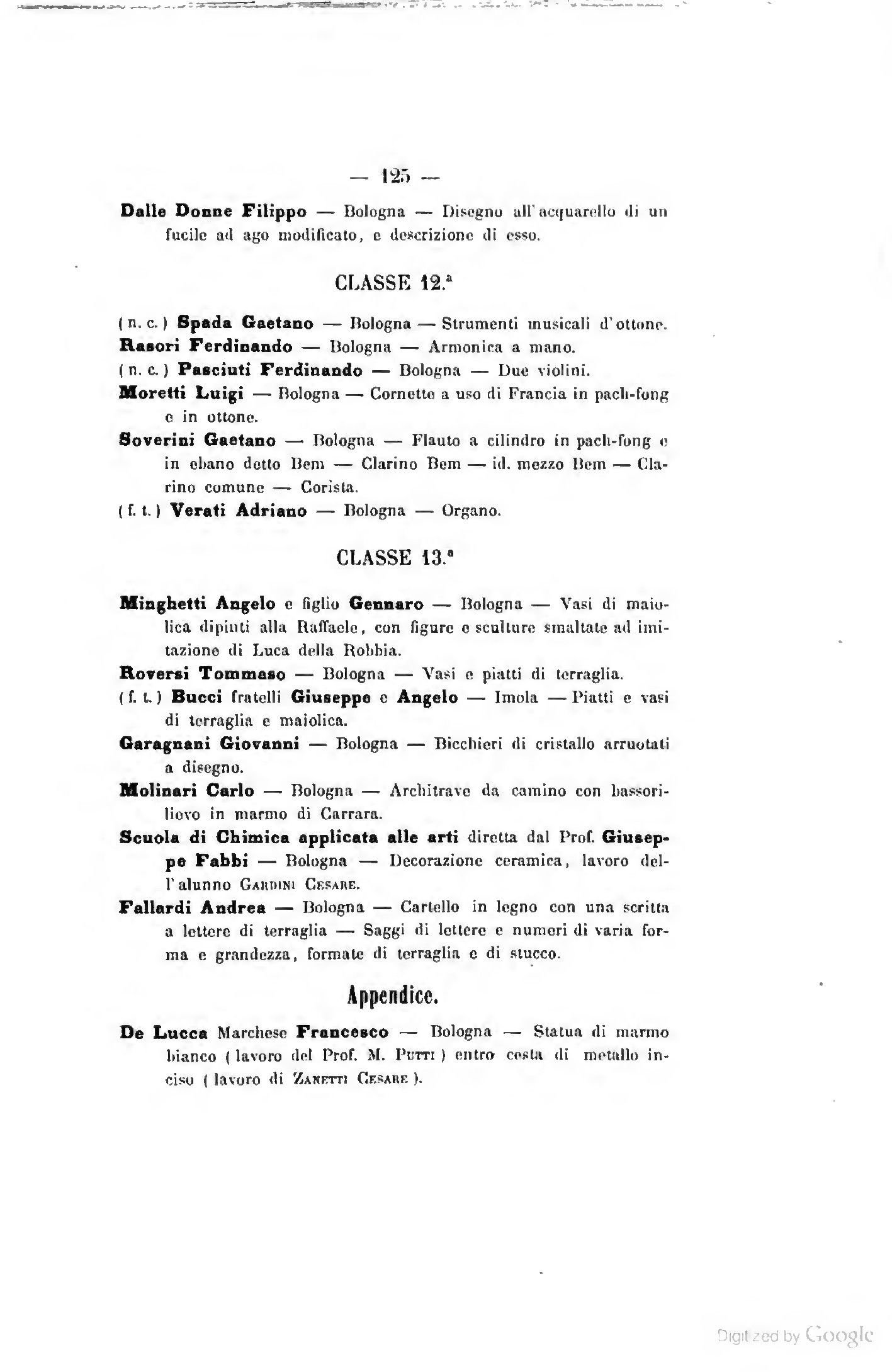
The exposition had a musical instrument class, and the ocarina is not in it. CLASSE 12.ª — Strumenti musicali held six exhibitors: Spada Gaetano (brass), Rasori Ferdinando (a hand harmonica), Pasciuti Ferdinando (two violins), Moretti Luigi (cornets), Soverini Gaetano (Boehm flute and clarinets), Verati Adriano (an organ). The pottery class on the same page, CLASSE 13.ª, holds maiolica and earthenware and no wind instrument of any kind.
There is no Budrio maker: Donati, Mezzetti, or otherwise. This does not show that the instrument was unknown or unsold. A maker may not have entered, or may have been refused. The document witnesses what was exhibited and judged.
Vienna, May 1 – November 2, 1873 — no ocarina in the instruments volume
The musical instruments volume of the official report on the Weltausstellung, issued separately, with strong controls: 80 bowed strings, 77 winds, 27 plucked. It has no ocarina in any spelling, and no Mezzetti, Donati, or Budrio. Italy’s showing was brass and strings — Pelitti of Milan took a progress medal for trumpets and machine timpani.
But the Budrio players were in Vienna that summer. The Mezzetti Ocarina Tutor — Alberto Napoleone Mezzetti’s own method book, published in London by Walter Brothers — reprints a press notice at the foot of its introduction:
Wien, Oestreich, 31ten Juli, 1873. — “CIRCUS-RENZ.—Etwas ganz neu und wunderbar ist eben hier aus Budrio, in Italien eingeführt worden, nämlich die Ocarina-Spieler, welche grosse Audienzen mit ihren bewunderungswürdigen Concerten anziehen.”
Something quite new and wonderful has just been brought here from Budrio, in Italy — the ocarina players, who draw great audiences with their admirable concerts.
So the Budrio players were in Vienna, at Circus Renz, in July 1873, the summer of the Weltausstellung. But the ocarina was not in the exhibition’s instrument report. The two findings are not in conflict. Together they say the group was in Vienna as performers and not as exhibitors, and it explains a silence that would otherwise look like absence.
Sydney, September 17, 1879 – April 20, 1880 — “a novelty in musical instruments”
Official Record of the Sydney International Exhibition, 1879, page 423, under CLASS 313.—Musical Instruments:
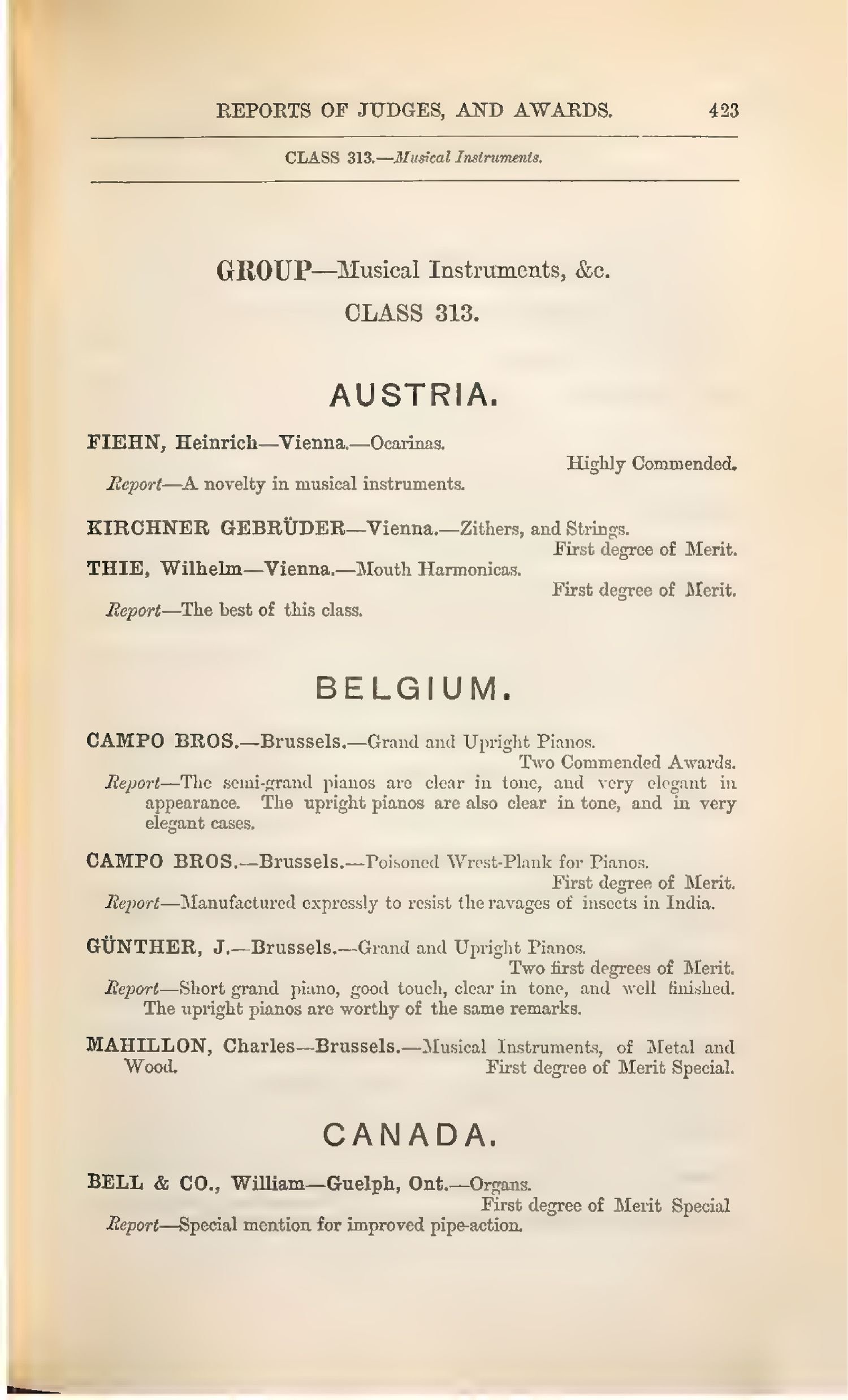
FIEHN, Heinrich—Vienna.—Ocarinas. Highly Commended. Report—A novelty in musical instruments.
The Sydney judges called the ocarina “a novelty in musical instruments” in 1879, twenty-six years after Donati.
This is also the exhibition Fiehn turned into his trade mark: the roundel on his method sheet reads “SYDNEY EXHIBITION 1879”, labeled Trade-Mark and Schutzmarke in print on either side.
Melbourne, October 1, 1880 – April 30, 1881 — Fiehn, and “Metzculini’s invention”
Three separate entries are found in the Official Record, and between them they give the exhibit, the jury’s words, and the award.
The exhibitor list, under Class 13, Musical Instruments, in the Austrian section, reads “Fiehn, H., Vienna.—‘Ocarina,’ and the necessary notes for schools.” In German a Schule is an instrument tutor, and at Frankfurt the next year the same maker’s entry reads “»Ocarina« mit ihren Schulen und Noten”, the ocarina with its method books and music. Fiehn’s own method sheet is titled Schule für Fiehn-Ocarinas. So “the necessary notes for schools” is very probably that same pair in translation, music and tutors for the ocarina, not material for classrooms.
The jury report says where the instrument came from:
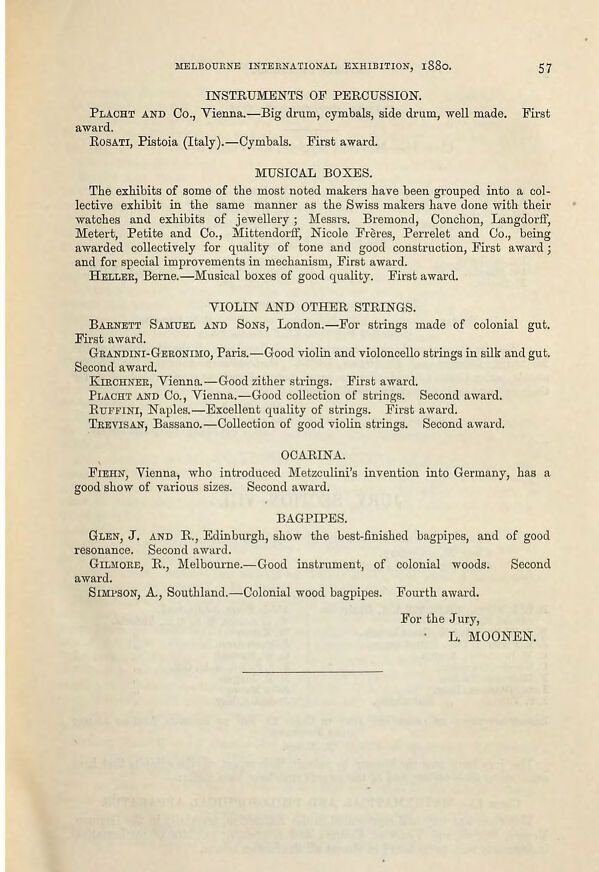
OCARINA. Fiehn, Vienna, who introduced Metzculini’s invention into Germany, has a good show of various sizes. Second award.
The page prints Metzculini, so whatever mangling happened, happened in 1880 — in the setting or in the hearing, not in a scanner. The jury section is signed “For the Jury, L. MOONEN”.
Whoever the juror was, the sentence says that a jury in 1880 understood Fiehn as having brought somebody else’s invention into Germany, not as its originator.
The official awards list confirms the grade:
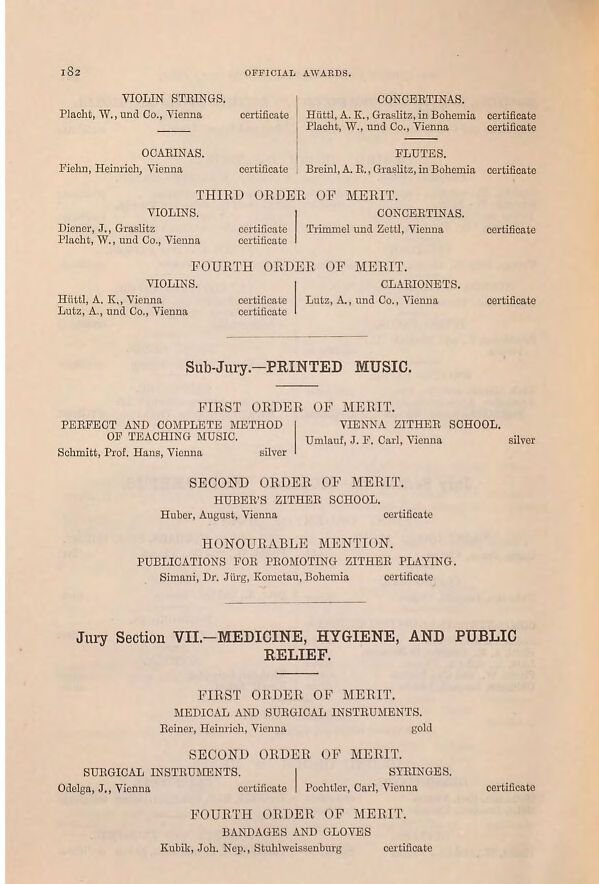
The record’s description of the Austrian court mentions ocarinas once more:
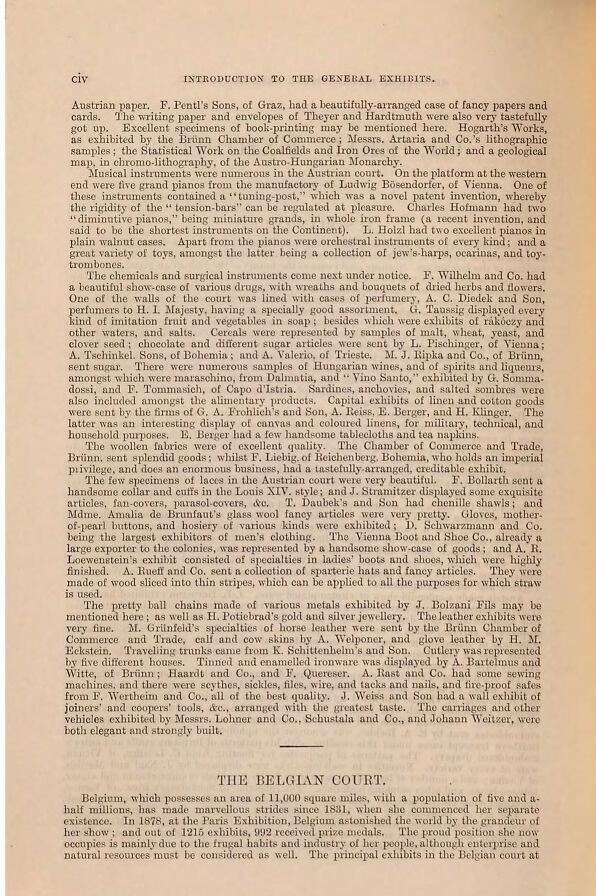
“a great variety of toys, amongst the latter being a collection of jew’s-harps, ocarinas, and toy-trombones.”
That passage counts them among the court’s toys. The exhibitor list puts Fiehn under Class 13, Musical Instruments, and the awards list under its section for musical instruments.
Frankfurt am Main, May 10 – October 17, 1881 — twenty-one sizes and keys
The Officieller Catalog der allgemeinen Deutschen Patent- und Musterschutz- und Local-Gewerbe-Ausstellung zu Frankfurt a. M. lists Fiehn twice. In Gruppe VIIa, page 64: “294. Fiehn, H., Wien, Occarinafabrik. Patent angemeldet. Occarina mit ihren Schulen und Noten.” In Gruppe XII, musical instruments, page 259:
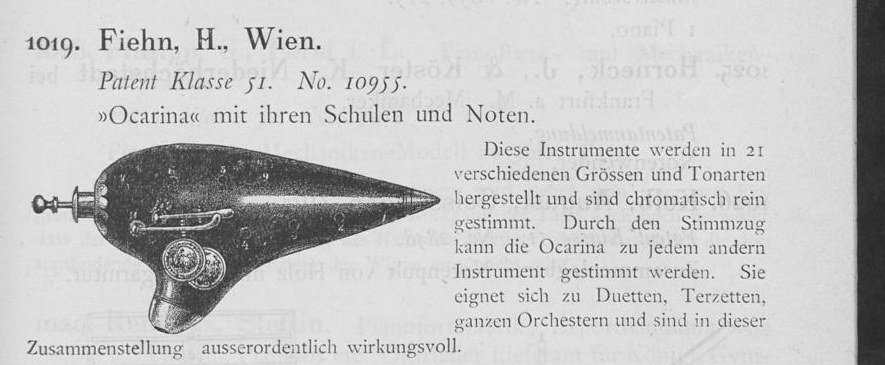
1019. Fiehn, H., Wien. Patent Klasse 51. No. 10955. »Ocarina« mit ihren Schulen und Noten. Diese Instrumente werden in 21 verschiedenen Grössen und Tonarten hergestellt und sind chromatisch rein gestimmt. Durch den Stimmzug kann die Ocarina zu jedem andern Instrument gestimmt werden. Sie eignet sich zu Duetten, Terzetten, ganzen Orchestern und sind in dieser Zusammenstellung ausserordentlich wirkungsvoll.
Twenty-one sizes and keys, chromatically tuned; a tuning slide to bring the ocarina into tune with any other instrument; suited to duets, trios, and whole orchestras. The entry prints a German patent number, Klasse 51, No. 10,955, which the museum has not yet identified.
Eger, July 31 – August 31, 1881 — H. Fiehn, a diploma
The Gewerbe- und landwirthschaftliche Ausstellung in Eger, Bohemia, now Cheb. No catalog of it has been found. Its prize list was printed in the Egerer Zeitung of September 3, 1881, and under Diplome ehrenvoller Anerkennung, diplomas of honorable recognition, it reads:
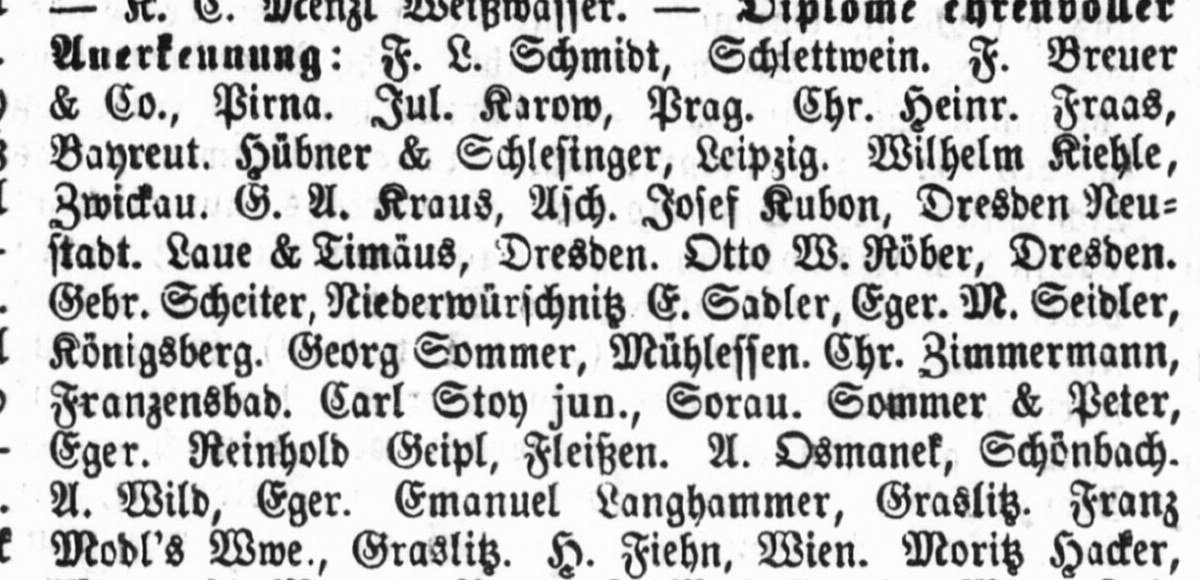
… Emanuel Langhammer, Graslitz. Franz Modl’s Wwe., Graslitz. H. Fiehn, Wien. Moritz Hacker, Wien. …
The list gives names and towns, not what each exhibitor showed.
Amsterdam, May 1 – October 31, 1883 — Fiehn and Kren
The Catalogue officiel de l’Exposition internationale, coloniale et d’exportation générale d’Amsterdam 1883, page 107, the Austro-Hungarian section, Classe 33, music and musical instruments:
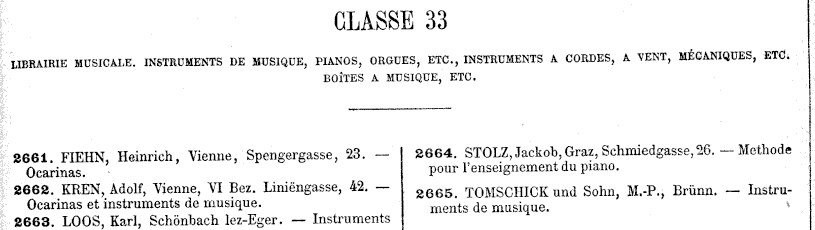
2661. FIEHN, Heinrich, Vienne, Spengergasse, 23. — Ocarinas.
2662. KREN, Adolf, Vienne, VI Bez. Liniëngasse, 42. — Ocarinas et instruments de musique.
Het nieuws van den dag reviewed the musical instruments on September 6, 1883: “Nog vindt men twee verzamelingen ocarina’s, eene van H. Fiehn en eene van Adolf Kren, beiden te Weenen. De ocarina’s van Fiehn zijn geperfectioneerde exemplaren met klappen.” Two collections of ocarinas, Fiehn’s and Kren’s, and Fiehn’s are improved instruments with keys.
Nice, December 1883 – May 1884 — Fiehn and Krenn
The Exposition internationale de Nice 1883–1884, Catalogue général officiel, second edition, page 68, among the Vienna exhibitors, Classe 74, wind instruments:

KRENN, Adolf, Vienne. — Ocarinas et pièces mosaïques. SE. | HEINRICH, Fiehn, Vienne. — Ocarinas. SE.
The catalog reverses Fiehn’s names and spells Kren with two ns.
Antwerp, May 2 – November 1885 — bronze-medal diplomas for Fiehn and Kren
The jury’s official list of awards, Liste officielle des récompenses (1886), Classe 8, musical instruments, under Diplômes de médaille de bronze:
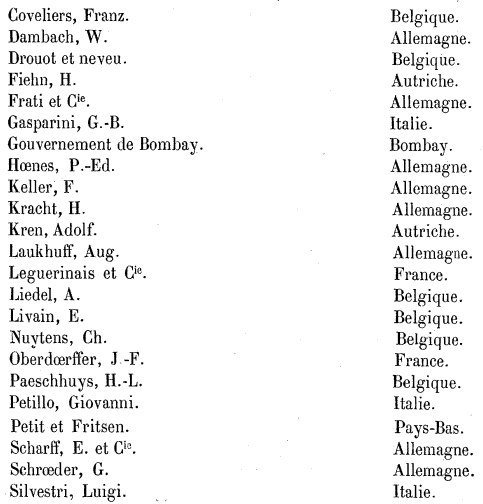
Fiehn, H. … Autriche. … Kren, Adolf. … Autriche. … Silvestri, Luigi. … Italie.
London, May 4 – November 9, 1885 — Mezzetti and Fiehn in the same building
International Inventions Exhibition 1885: Official Catalogue. Division I covered inventions “brought into use since 1862”; Division II was Music. Two entries, two hundred apart in one numbered sequence.
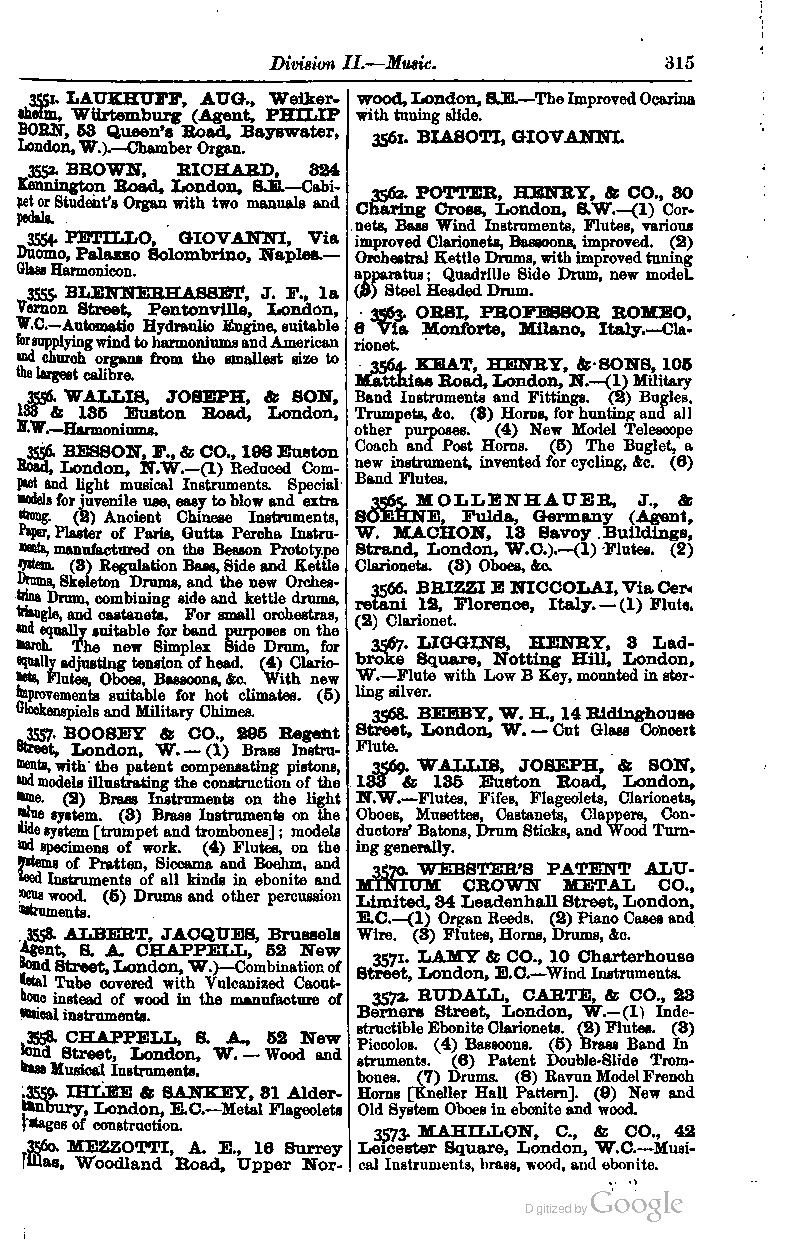
- MEZZOTTI, A. E., 16 Surrey Villas, Woodland Road, Upper Norwood, London, S.E. — The Improved Ocarina with tuning slide.
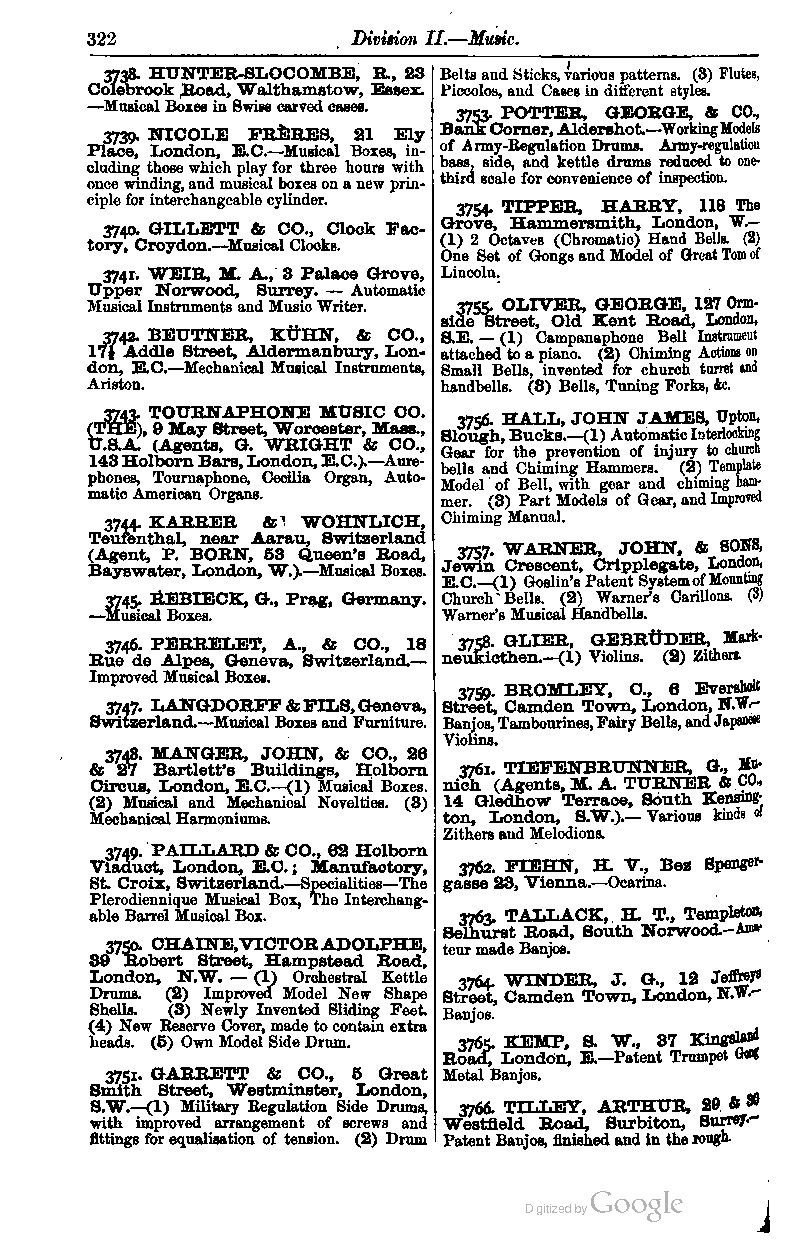
- FIEHN, H. V., Bez Spengergasse 23, Vienna. — Ocarina.
Entry 3560 is Mezzetti, misspelled, and this page treats it so. The catalog prints MEZZOTTI, A. E., a surname that exists in its own right; the initials are taken up below. What the entry describes is Mezzetti’s: an ocarina with a tuning slide, the device of the Mezzetti British patent of 1878, shown from a London address.
Fiehn’s German patent, DE 16,668, filed March 15, 1881, also claims a tuning slide. The plate in Mezzetti’s tutor, “MEZZETTI’S PATENT. No. 2170.”, is the British patent of 1878.
Fiehn and Mezzetti exhibited in the same building in 1885.
Fiehn’s address was Spengergasse 23 in 1885 and Hofgasse 4 by 1888, both in Vienna’s fifth district.
London 1885 is not on Fiehn’s own list, which has London 1884 and Anvers 1885. His list records awards, not appearances — so the fourteen exhibitions on that sheet are a floor, not a total.
Two records give the name as A. E.: the London entry above, and the Stearns Collection catalog of 1918, which transcribes the signature on a Mezzetti ocarina in Michigan as “Fabricateur, A. E. Mezzetti, a Paris.” The brothers’ known names are Ercole (1841–1918) and Alberto Napoleone (1843–1906), and The Mezzetti Ocarina Tutor carries an author’s preface signed, in both its English and its French column:
A. N. MEZZETTI.
What A. E. stands for is not known. It could be the two brothers together, though Ercole was the elder, or an N misread as an E, by a London compositor and by a cataloger in Michigan, whose catalog prints “H. Viehn, Vienna” for Fiehn on the facing entry. Ercole’s own French patents, FR 170,367 of 1885 and FR 220,556 of 1892, name him only as Ercole. No document found so far says which.
London, May 12 – October 31, 1888 — Fratelli Mezzetti of Budrio
The Italian Exhibition in London. Its award list is printed in Four National Exhibitions in London and Their Organiser (1892), page 479, under Class XIV, Music and Musical Instruments:

- Diploma. … Mezzetti, Flli., Budrio, for ocarine.
Flli. is Fratelli, brothers: the Mezzetti firm, entered from Budrio. The Music Trades Review printed the same name, “Flli. Mezzetti, Budrio (Pr. di Bologna), ocarina”, in a list of Italian exhibitors on June 15, 1888.
Vienna, May 14 – November 1, 1888 — an address, a factory, and Adolf Kren
Katalog der Jubiläums-Gewerbe-Ausstellung Wien 1888, Gruppe XVIII, Bau musikalischer Instrumente.
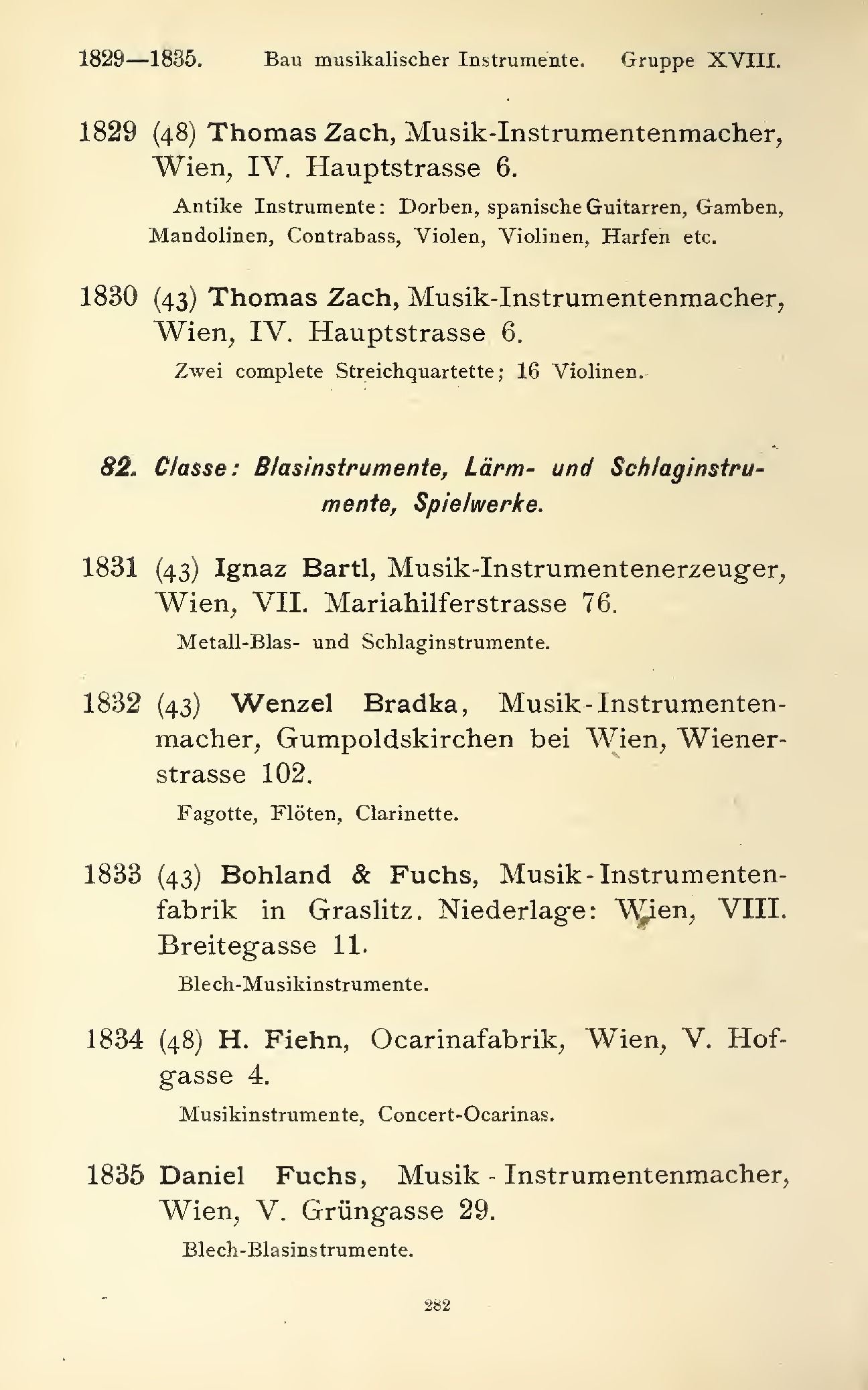
1834 (48) H. Fiehn, Ocarinafabrik, Wien, V. Hofgasse 4. Musikinstrumente, Concert-Ocarinas.
The entry gives Fiehn’s address in 1888, Hofgasse 4 in Vienna’s fifth district. It calls the business an Ocarinafabrik, an ocarina factory, rather than a general instrument works, and it names a product line, Concert-Ocarinas.
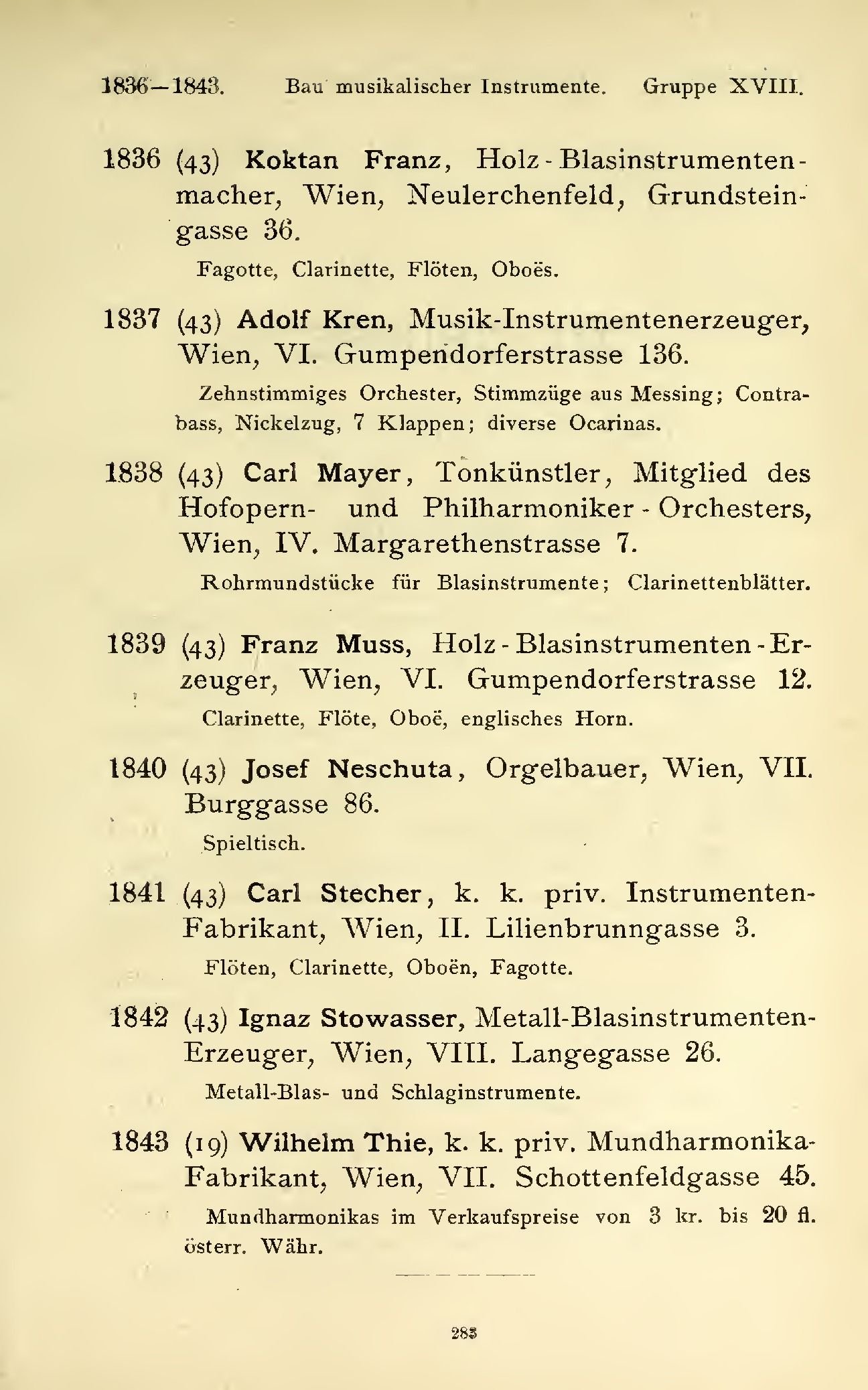
1837 (43) Adolf Kren, Musik-Instrumentenerzeuger, Wien, VI. Gumpendorferstrasse 136. Zehnstimmiges Orchester, Stimmzüge aus Messing; Contrabass, Nickelzug, 7 Klappen; diverse Ocarinas.
Adolf Kren, who had shown ocarinas beside Fiehn at Amsterdam and Nice and was on the Antwerp award list with him, is three entries after him. Before “diverse Ocarinas” his entry lists a ten-voice orchestra with brass tuning slides and a contrabass with a nickel slide and seven keys; it does not say whether those were ocarinas too. The catalog calls him a Musik-Instrumentenerzeuger, a maker of musical instruments in general.
Gruppe XVIII has twenty-six exhibitors, entries 1818 to 1843, and two of them name ocarinas. The rest are zither makers, violin makers, brass and woodwind works, an organ builder, and a harmonica factory.
Chicago, May 1 – October 30, 1893 — a clean negative
Official catalogue of exhibits, World’s Columbian Exposition, nearly six million characters. The musical instrument classes are large and well populated — 50 plucked, 50 bowed, 31 wind, pages of Paris houses. There is no ocarina, in any spelling.
One name needs care: entry 35 reads “Ullmann, Paris. Electric pneumatic piano.” Ocarinas marked ULLMANN-PARIS / SYST. RODA survive, one of them in the Library of Congress, but an electric pneumatic piano is not an ocarina. Same city, same surname, different instrument. The entry is recorded here, not identified.
Paris, April 15 – November 12, 1900 — Ercole Mezzetti, in two sections
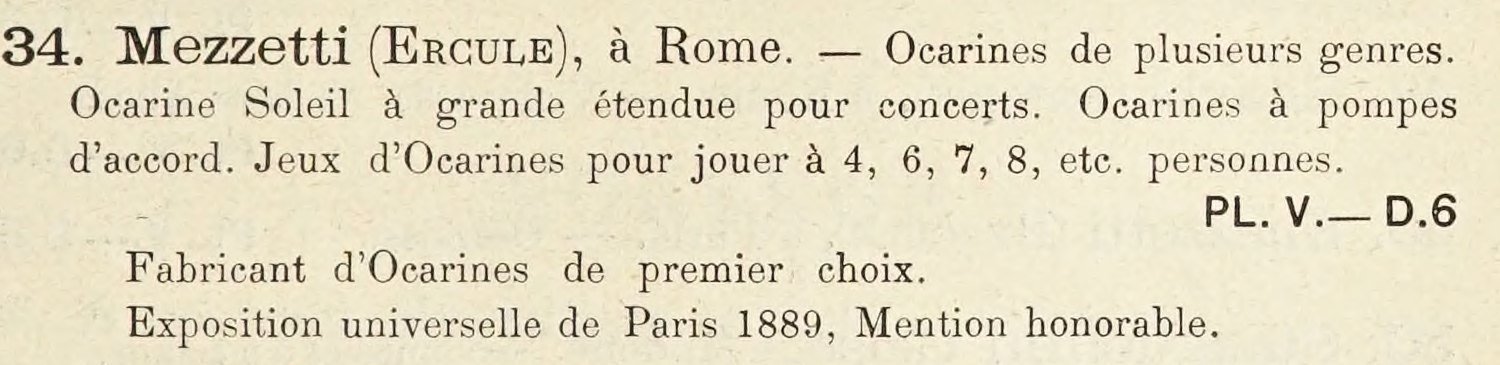
The Catalogue général officiel of the 1900 Exposition universelle, volume 3, Groupe III, Classe 17, page 43, lists in its Italian section “34. Mezzetti (Ercule), à Rome. — Ocarines de plusieurs genres… Jeux d’Ocarines pour jouer à 4, 6, 7, 8, etc. personnes”, and the same entry claims “Exposition universelle de Paris 1889, Mention honorable.”
Volume 14 lists him a second time, in the French section of Groupe XII, Classe 72, ceramics, page 30:
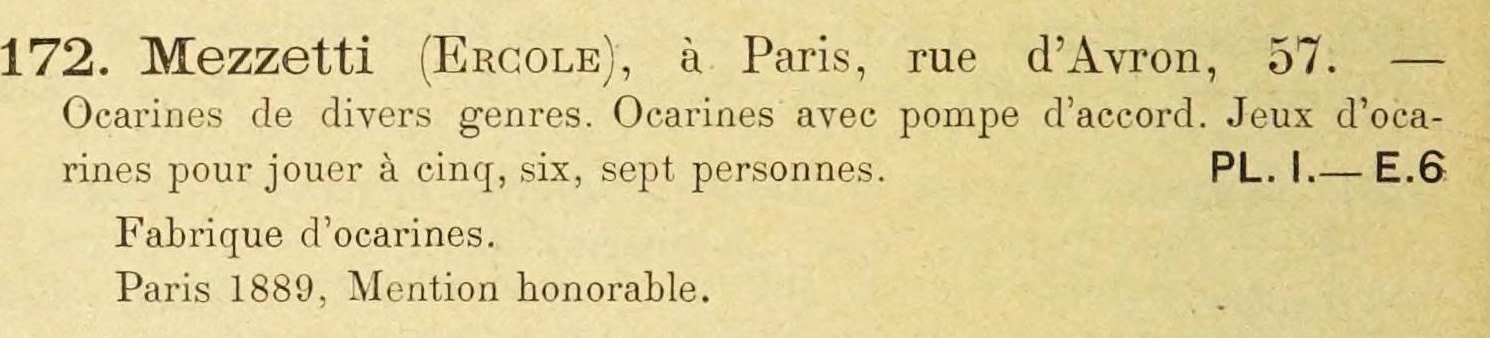
172. Mezzetti (Ercole), à Paris, rue d’Avron, 57. — Ocarines de divers genres. Ocarines avec pompe d’accord. Jeux d’ocarines pour jouer à cinq, six, sept personnes. … Fabrique d’ocarines. Paris 1889, Mention honorable.
So the same maker was shown as an Italian instrument maker from Rome and as a Paris ocarina factory among the French potters. The mention honorable that both entries claim is in the 1889 jury’s award list for Classe 13, “Mezzetti. — Italie.”, given among the exotic collections.
The 1900 jury’s report, volume 3, page 560, under “Musettes. — Flûtes moulées. — Ocarinas”, describes three ocarina houses:
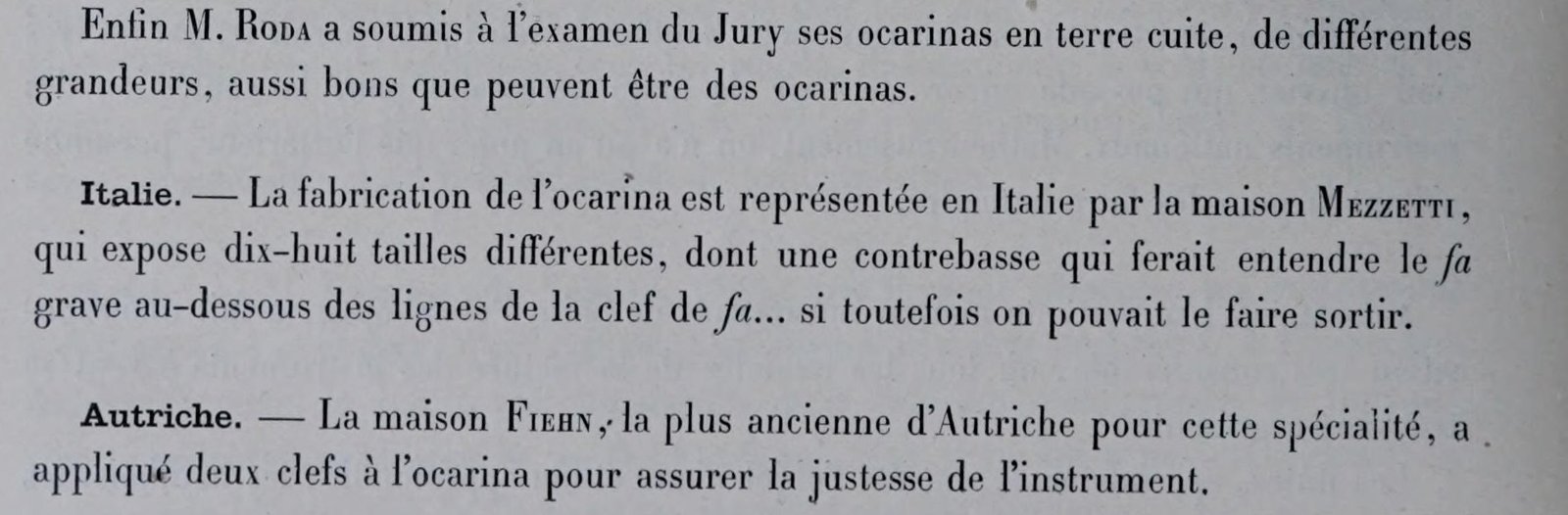
Enfin M. Roda a soumis à l’examen du Jury ses ocarinas en terre cuite, de différentes grandeurs, aussi bons que peuvent être des ocarinas.
Italie. — La fabrication de l’ocarina est représentée en Italie par la maison Mezzetti, qui expose dix-huit tailles différentes, dont une contrebasse qui ferait entendre le fa grave au-dessous des lignes de la clef de fa… si toutefois on pouvait le faire sortir.
Autriche. — La maison Fiehn, la plus ancienne d’Autriche pour cette spécialité, a appliqué deux clefs à l’ocarina pour assurer la justesse de l’instrument.
Roda showed terracotta ocarinas of different sizes, “as good as ocarinas can be”; the Mezzetti house showed eighteen sizes, including a contrabass meant to sound the F below the bass staff, “if one could get it to sound”; and the Fiehn house, “the oldest in Austria for this specialty”, had added two keys to keep the ocarina in tune. Fiehn’s own list of exhibitions ends at Vienna 1888 and does not include Paris 1900.
What can be speculated
“Metzculini” is probably an Italian name taken by ear. The Sydney 1879 record lists “MOONEN, Léon—Paris.—History of Harmoniums” among its exhibitors. If the juror L. Moonen is that Léon Moonen of Paris, he was a Paris exhibitor serving on a Melbourne jury and writing in English, and may have rendered a name he had heard rather than copied. The obvious candidate is Mezzetti. The museum does not assert it. The word appears exactly once in the Melbourne record and nowhere in the Sydney one, and neither document contains Budrio or Donati at all.
The other spellings may be the same name. Mezzotti at London in 1885 is Mezzetti misset, as above. Metzculini at Melbourne in 1880 and Bezzetti in Fabricantes de tonadas, the Fundación Joaquín Díaz’s Valladolid exhibition catalog of 2024, are consistent with the same name misheard or misset, and also with other families.
Fiehn may have heard the Budrio players in Vienna. They played Circus Renz in July 1873; Fiehn’s first listed award is Linz und Ried, 1877. The timing allows it. No document the museum has read connects the two events, and the accounts that connect them cite nothing.
What is still missing, and what each would fill
| wanted | what it would settle |
|---|---|
| Esposizione Emiliana, Bologna, 1888 — official catalog | Whether the Budrio makers exhibited in their own province. Fratelli Mezzetti of Budrio won a third-class diploma for ocarinas at the Italian Exhibition in London that year. The Bologna exhibition is where they, or Cesare Vicinelli, would have shown at home. |
| Vienna 1880 and 1884 | The two remaining Vienna entries on Fiehn’s sheet: what he showed, and whether other Vienna ocarina makers showed beside him, as Kren did in 1888. |
| Paris 1889 — the official catalog | What Mezzetti showed, and from where. The jury’s award list gives “Mezzetti. — Italie.” a mention honorable among the exotic collections of Classe 13, and both of Ercole’s 1900 entries claim that award. |
| Milan 1881, Turin 1884 — industrial volumes | The national Italian exhibitions of the decade. |
| The four remaining exhibitions on Fiehn’s sheet, besides Vienna above | Whether his own list is accurate, and what he showed at each. Linz und Ried 1877, Teschen 1880, Triest 1882, London 1884. Eight of the fourteen are accounted for so far: Sydney, Melbourne, Frankfurt, Eger, Amsterdam, Nice, Antwerp, and Vienna 1888. |
| The six press notices the tutor reprints | Each has a paper, a city, and a date. The Vienna one is in ANNO’s range; the London one in the British Newspaper Archive; the Paris one in Gallica. Finding the papers would confirm the quotations the tutor chose to reprint. |
| Philadelphia 1876 — Department II (Manufactures) | The volume where Class 327 exhibitors are listed, and the one not yet read. Until then, whether the ocarina was shown at the Centennial is open, and the museum says neither way. |
When a negative counts
Three of the findings above are absences — Bologna 1869, Vienna 1873, Chicago 1893 — and an absence is only worth printing under conditions.
The catalog must have a class where the thing would have sat; that class’s list must be legible; somebody must actually have exhibited in it; and something that must be in the document must be found in it. Bologna 1869 passes all four, which is why its empty CLASSE 12 is a finding. Philadelphia 1876 fails the second, which is why it is marked inconclusive above and not negative.
A clean negative is a fact about one document. It says the ocarina was not in that catalog. It does not say the ocarina was not in that country, that city, or that year.
Where these catalogs are
Every exhibition volume quoted is long out of copyright and served in full online. The links are below, and the museum holds its own copy of each page quoted. Two other printed sources are not online: The Mezzetti Ocarina Tutor, quoted for its press notices and its preface, and Fiehn’s method sheet, whose list of awards is photographed from the sheet in the museum’s collection. The dates in the headings come from the exhibitions’ own catalogs and reports, newspapers, and other accounts of the time; the museum’s research notes record the source of each.
| exhibition | volume | identifier |
|---|---|---|
| Bologna, 1869 | Esposizione agraria ed industriale della provincia di Bologna | vol. 1 · vol. 2 |
| Vienna, 1873 | Bericht über Gruppe 8 · Amtlicher Bericht | 11305026bsb · amtlicherberich01weltgoog |
| Sydney, 1879 | Official Record | 11889800bsb |
| Melbourne, 1880–81 | Official Record | 11889597bsb |
| Frankfurt, 1881 | Officieller Catalog der allgemeinen Deutschen Patent- und Musterschutz- … Ausstellung | e-rara, ETH-Bibliothek Zürich |
| Eger, 1881 | Egerer Zeitung, September 3, 1881, the prize list | Czech National Library, Kramerius |
| Amsterdam, 1883 | Catalogue officiel | Cnum, 4XAE29 |
| Nice, 1883–84 | Catalogue général officiel, 2nd ed. | Gallica, bpt6k9002539 |
| Antwerp, 1885 | Liste officielle des récompenses (1886) | Cnum, 8XAE322.6 |
| London, 1885 | International Inventions Exhibition, Official catalogue | officialcatalog01exhigoog |
| London, 1888 | Four National Exhibitions in London and Their Organiser (1892), the Italian Exhibition’s award lists | fournationalexhi00lowe |
| Vienna, 1888 | Katalog der Jubiläums-Gewerbe-Ausstellung | katalogderjubila00jubi |
| Paris, 1889 | Rapports du jury international, Classe 13 | rapportsdujuryin22expo |
| Chicago, 1893 | Official catalogue of exhibits | officialcatalog00ivesgoog |
| Paris, 1900 | Catalogue général officiel, vol. 3 | HathiTrust gri.ark:/13960/t7qp43s5m |
| Paris, 1900 | Catalogue général officiel, vol. 14 | cataloguegeneral14expo |
| Paris, 1900 | Rapports du jury international, vol. 3 | rapportsdujuryin03expo_0 |
| Mezzetti tutor | The Mezzetti Ocarina Tutor, London: Walter Brothers, undated | not online |
| Valladolid, 2024 | Fabricantes de tonadas: constructores de Instrumentos Musicales en Valladolid, Fundación Joaquín Díaz, page 22 (Bezzetti) | Fundación Joaquín Díaz |
Three more were read and gave no conclusion either way: London’s International Health Exhibition of 1884 (gri_33125008618163), Antwerp 1885 (gri_anversetlexp00corn), and Manchester 1887 (royaljubileeexhi00roya).