Trade Catalogs, 1878–1930
Wholesalers, mail-order houses, and what they printed about ocarinas
C. Bruno & Son, Hamilton S. Gordon, R. S. Williams, Montgomery Ward, and Sears, Roebuck: half a century of American and Canadian trade catalogs, the Viennese and French lines they stocked, and what a catalog’s silence does not mean.
Every claim below names the document it came from, and every page image is reproduced from a scan the museum holds. Where a page is missing, misspelled, or illegible, the page says so. Research and drafting were done with help from Claude, Anthropic’s AI assistant.
An exhibition catalog records what a maker chose to show once. A trade catalog records what a house offered for sale, and at what price, edition after edition. For the ocarina, the trade catalogs show how the instrument was offered to dealers and households in the United States and Canada.
A companion article, Exhibition Catalogs, 1869–1900, covers the other half.
What a trade catalog is, and the three kinds
They are not all the same document, and the differences determine what each can prove.
| kind | example here | what it shows |
|---|---|---|
| Wholesaler’s list | C. Bruno & Son, New York, 1890 | what a jobber offered to dealers, under the maker’s name and a trade numbering |
| Mail-order “big book” | Sears, Roebuck; Montgomery Ward | what a mass-market house sold direct to households, under its own stock numbers |
| Specialist house list | Hamilton S. Gordon; R. S. Williams | a music dealer’s own book, mixing imported lines with house brands |
They also number differently. Two of these houses print an identical set of model numbers for the Viennese instruments; the mail-order houses print numbers of their own that change with the catalog.
How the museum found them
Most of these catalogs were found in the Internet Archive’s mail-order holdings, and others by searching for a maker’s name once one page printed it. Three documents in the table of what is still missing are known because patent examiners cited them as prior art; they are in the museum’s patent register.
What the museum has recovered
Each volume below has been searched and has a recorded verdict, including those that found nothing.
| year | house and edition | result | held as |
|---|---|---|---|
| 1878 | Montgomery Ward, No. 21, Spring | nothing to read either way — the catalog itemizes no instruments at all, offering “all kinds” on request | OCR |
| 1890 | C. Bruno & Son, New York | hit — four product lines under Fiehn’s name | |
| 1897 | Sears, Roebuck, No. 104, Spring | hit — “Fiehn’s Vienna Make” | page images |
| 1897 | Hamilton S. Gordon, New York | hit — a clay line and a French metal line | |
| 1897 | Lyon & Healy, Washburn styles | nothing to read either way — a catalog of Washburn’s own guitars and mandolins, so ocarinas were never its trade | OCR |
| 1902 | Sears, Roebuck, No. 111, Spring | hit — “Fiehn’s Vienna Make” | page images |
| 1911 | Sears, Roebuck, No. 122, Spring | hit — no maker named | page image |
| 1911 | R. S. Williams, Toronto, No. 32 | hit — the Viennese numbers, no maker named | |
| 1912 | Sears, Roebuck, No. 124 | hit — no maker named | |
| 1916 | Montgomery Ward, No. 132 | hit — “Genuine Vienna Ocarinas” | page image |
| 1920–1924 | Montgomery Ward, one volume a year | hits — wording varies, no maker | page images |
| 1922 | Sears, Roebuck, No. 144, Spring | no conclusion — 42 pages absent from the scan | page images |
| 1926 | Montgomery Ward, No. 104, Spring and Summer | negative for that season | page images |
| 1927 | Montgomery Ward | negative for that season | page images |
| 1929–30 | Montgomery Ward, No. 111, Fall and Winter | hit — “Genuine H. Fiehn Ocarinas” | page image |
| 1929–30 | Sears, Roebuck, No. 159, Fall and Winter | hit — no maker named, page 736 | page image |
What the catalogs say
C. Bruno & Son, New York, 1890 — four lines under Fiehn’s name
An American musical instrument wholesaler, the tier between the Vienna factory and the mail-order houses. The contents index reads OCARINAS 248, and the section carries a two-line heading, the instrument and then the maker:
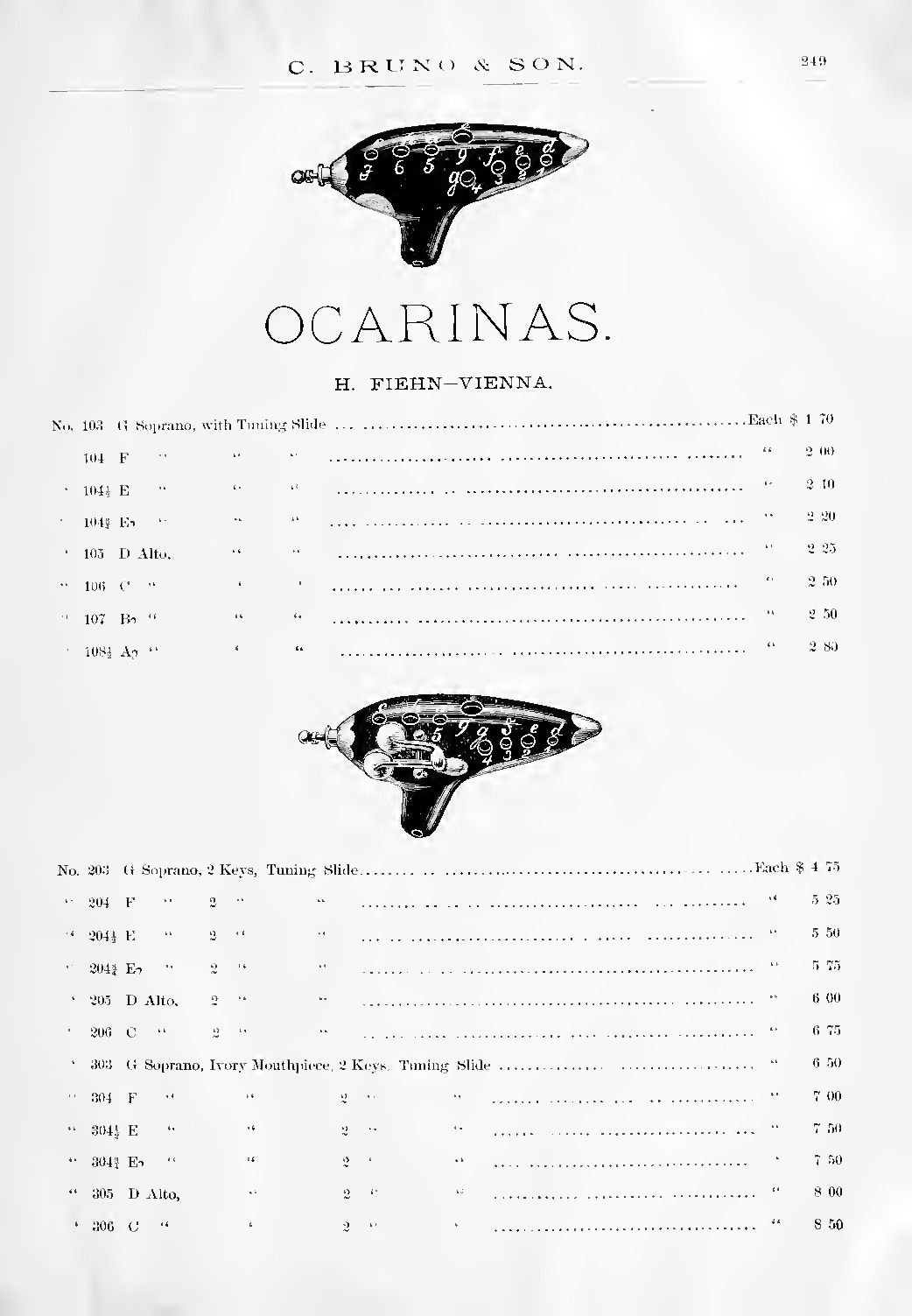
OCARINAS. H. FIEHN—VIENNA.
Four distinct product lines, with model numbers and prices each:
| line | numbers | as printed | price each |
|---|---|---|---|
| plain | 1–21 | C Soprano (4¼ inches) to Contra-Bass, Extra Size C (14½ inches) | $0.35 – $7.75 |
| tuning slide | 103–108½ | “G Soprano, with Tuning Slide”, F, E, E♭, D Alto, C, B♭, A♭ | $1.70 – $2.80 |
| keyed | 203–206 | “G Soprano, 2 Keys, Tuning Slide”, and F, E, E♭, D Alto, C the same | $4.75 – $6.75 |
| ivory | 303–306 | “G Soprano, Ivory Mouthpiece, 2 Keys, Tuning Slide” | $6.50 – $8.50 |
Keyed ocarinas were a cataloged product line in 1890, with two keys at every size from G soprano to C alto, and so were tuning-slide ocarinas, with model numbers and prices of their own. Both features are claimed in the German patent of 1881 of Heinrich Fiehn, the Vienna maker, DE 16,668, which covers keys marked F-sharp and G “zur Vermehrung des Umfanges”, a mouthpiece set into the blowing opening, and “die Anordnung des Stimmzuges”, the arrangement of the tuning slide. The catalog does not say that the instruments it lists were made under the patent.
Soprano, alto, bass, contra bass
Bruno runs from C Soprano through D Alto to Contra-Bass, Extra Size C at 14½ inches, and Williams prints the same four words in Toronto twenty-one years later. Bruno’s 1890 list is the earliest of the catalogs on this page to use them.
Prima/Aketa in Japan named its models differently: Piccolo, Cornettino, Larigho, Doubllette, Cornetta, Alto, Tenor, and Bass. The names borrow from the recorder and cornett families rather than from these lists; the sizes are set out on the museum’s page for the Prima Cornetta M5C.
R. S. Williams, Toronto, 1911 — the Viennese runs again, twenty-one years later
Catalogue no. 32 of musical merchandise, page 321, headed:
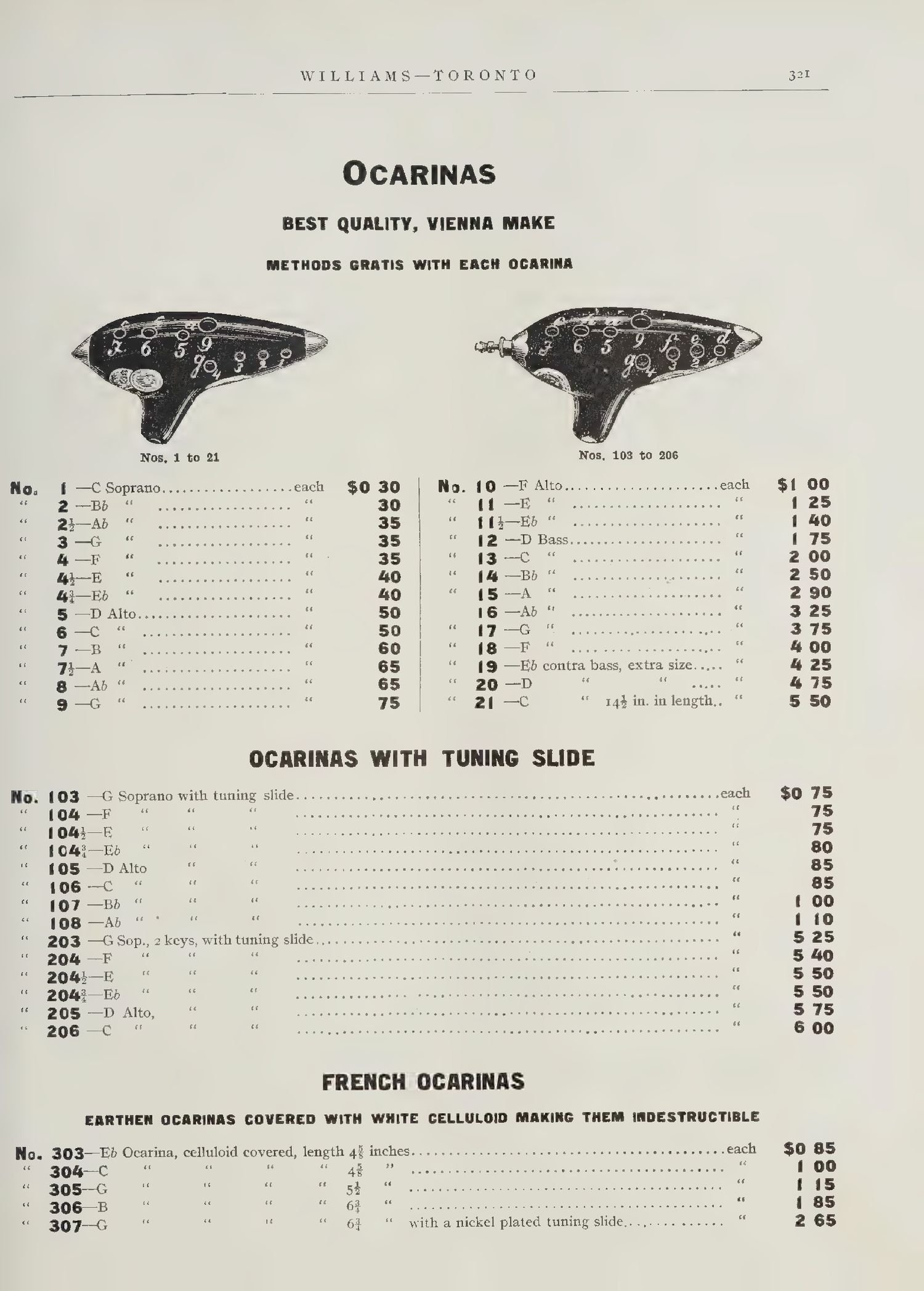
OCARINAS BEST QUALITY, VIENNA MAKE METHODS GRATIS WITH EACH OCARINA
Two engravings sit side by side at the head of the page, each with its number range set beneath it: “Nos. 1 to 21” under the plain instrument on the left, “Nos. 103 to 206” under the one with a tuning slide on the right. Three runs follow: the plain line 1–21, closing at “21 —C 〃 14½ in. in length”, with the page’s ditto mark; then “OCARINAS WITH TUNING SLIDE”, which covers both 103–108 and the keyed 203–206, “G Sop., 2 keys, with tuning slide”.
The two houses use the same numbers for the same instruments. Bruno in New York in 1890 and Williams in Toronto in 1911 both run 1 to 21, 103 to 108, 203 to 206, with the same 14½-inch contra bass closing the plain line and the same fractional numbers — 104½ for E, 104¾ for E♭ — in the slide run. Twenty-one years and an international border apart, that is not independently invented.
Williams’s plain line also carries 2½ (A♭), 4½ (E), 4¾ (E♭), 7½ (A), and 11½ (E♭), each between two whole numbers. That pattern suggests sizes added later, in keys the original run of twenty-one did not cover, though neither catalog says so.
Whose numbers they are is not settled. They could be the factory’s or the wholesale trade’s, and the catalogs do not say. What the museum can add is from its own shelves: Fiehn ocarinas with a tuning slide or keys carry the same impressed numbers as the plain ones, so the 100-, 200-, and 300-series are not what was stamped on the instruments. Whether Fiehn issued them for his trade lists or a wholesaler built them is an open question.
Hamilton S. Gordon of New York, in the same period, used 1510 to 1538 for clay ocarinas and 1540 to 1546 for French ones, numbers that belong to Gordon’s book and change with it.
The correspondence is not total. Bruno’s 303–306 is Fiehn’s ivory mouthpiece line. Williams’s 303–307 is something else entirely:
FRENCH OCARINAS EARTHEN OCARINAS COVERED WITH WHITE CELLULOID MAKING THEM INDESTRUCTIBLE No. 303—E♭ Ocarina, celluloid covered, length 4⅝ inches … 307—G … with a nickel plated tuning slide
So the 300-series carries a different product in each catalog, and the prices say the same thing: Bruno’s 303 is $6.50, Williams’s is $0.85. A number alone is not an identification.
What transfers between the two houses is the Viennese sequence, 1–21, 103–108, and 203–206, and within those runs a number is evidence: 103 is a G soprano with a tuning slide whether it turns up in New York in 1890 or Toronto in 1911. Outside them, a number has to be read with the line heading above it.
Hamilton S. Gordon, New York, 1897 — two national traditions on one page
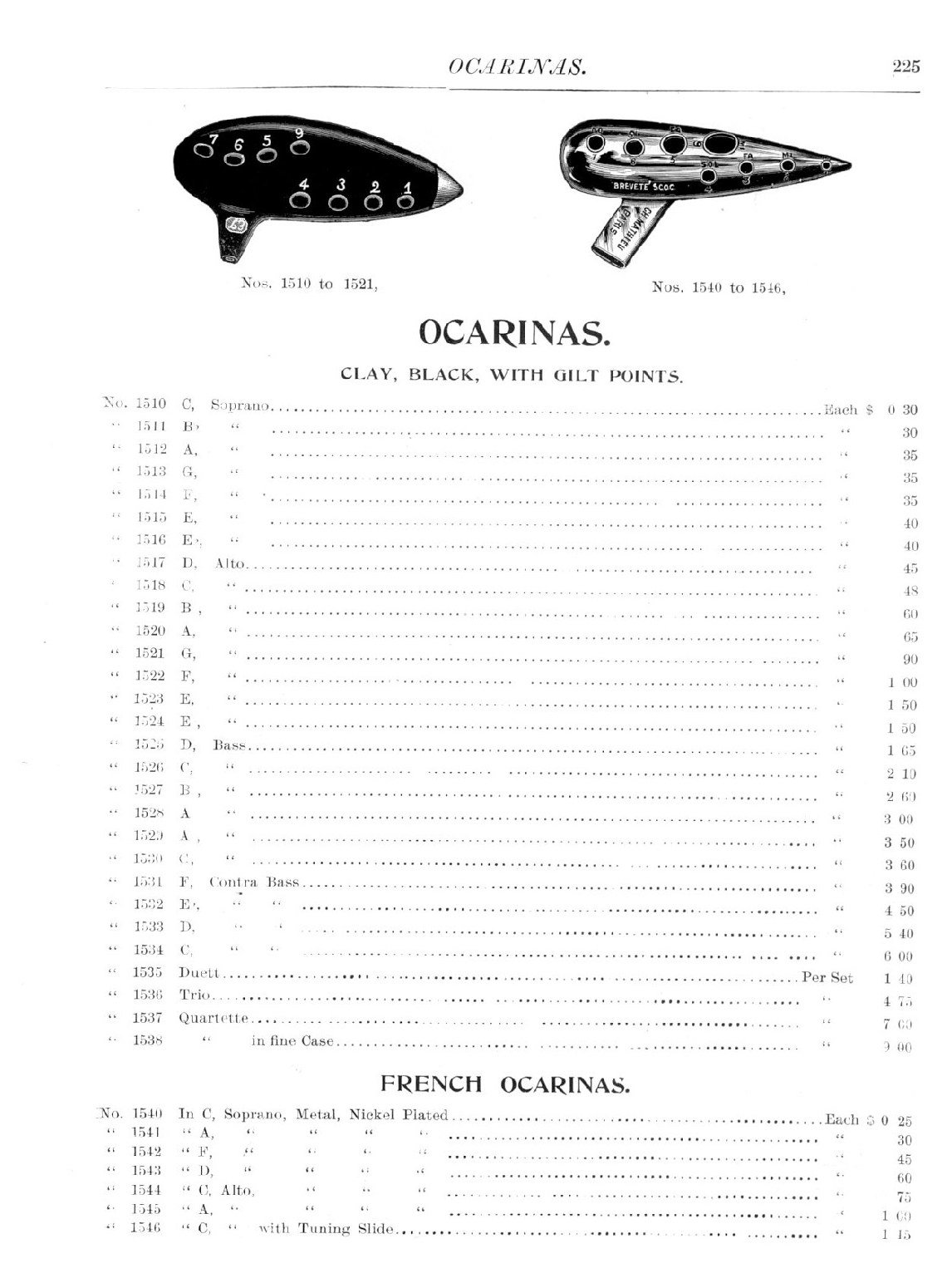
OCARINAS. CLAY, BLACK, WITH GILT POINTS. No. 1510 C, Soprano… Each $0.30 … 1531 F, Contra Bass… 3.90 … 1534 C… 6.00 … 1535 Duett… Per Set 1.40 … 1536 Trio… 4.75 … 1537 Quartette… 7.00 … 1538 ” in fine Case… 9.00
FRENCH OCARINAS. No. 1540 In C, Soprano, Metal, Nickel Plated… Each $0.25 … 1544 C, Alto… 0.75 … 1546 C, with Tuning Slide… 1.15
Two engravings sit side by side above the lists, each with a line of type beneath it giving a number range: “Nos. 1510 to 1521” under the clay instrument on the left, “Nos. 1540 to 1546” under the metal one on the right. The clay list runs past its engraving, to 1538: twenty-five sizes from C soprano to C contra bass, then a duet, a trio, and a quartet, with 1538 the quartet again in a fine case.
The French line is metal and nickel-plated, and its last number, 1546, has a tuning slide. It was offered in New York in 1897, the year Sears offered Viennese clay ocarinas by mail. An American house offering both traditions at once is what makes the metal French instrument a commercial line rather than a curiosity.
The catalog names no maker for either line, but both engravings can be placed. The left one matches Teschner ocarinas in the museum’s collection, by the distinctive stamp on the mouthpiece — the museum’s own attribution, from instruments it holds. The right one is a Mathieu, and the engraving says so itself: enlarged, the mouthpiece is lettered CH. MATHIEU. That is the Paris maker whose metal ocarinas the Library of Congress holds as DCM 1002 and 1004, both stamped CH. MATHIEU / PARIS, and whose FR 212,700 of 1891 claims a nouveau genre d’ocarine métallique. Whether he supplied Gordon is a separate question: the price list names no maker.
The clay line’s key sequence is the Viennese one: C soprano down through the altos and basses to a C contra bass, the same run Bruno prints under Fiehn’s name and Williams under “VIENNA MAKE”, renumbered into Gordon’s own 1510s. So the engraving and the line it sits above may not be the same instrument. A catalog house reused whatever cut it had, and an illustration is not a purchase order. What the page establishes is the offer; who supplied it is an inference, and it is marked as one.
Sears, Roebuck, 1897 — “Fiehn’s Vienna Make”
Consumers Guide, Catalogue No. 104, Spring 1897, page 532.
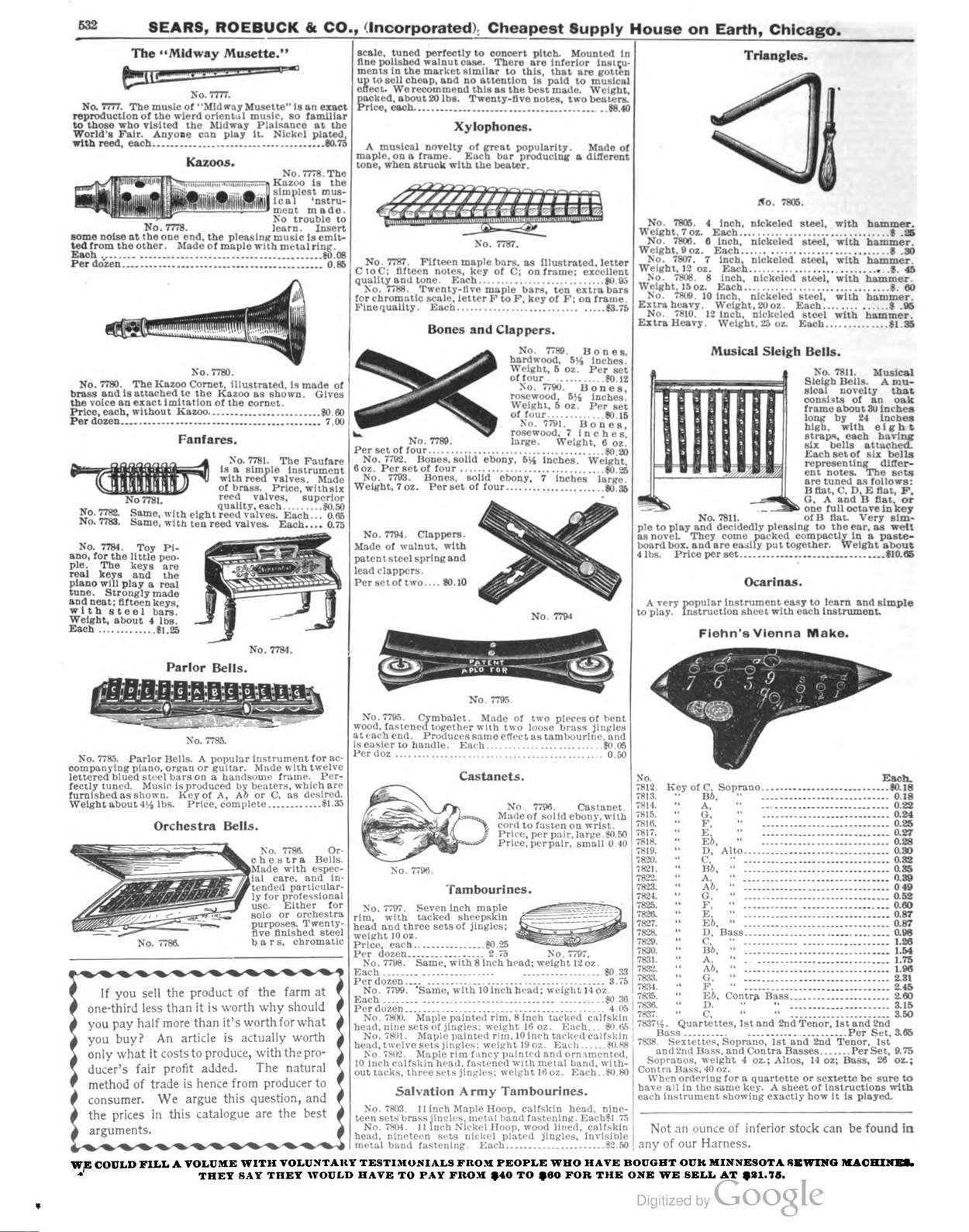
Ocarinas. “A very popular instrument easy to learn and simple to play. Instruction sheet with each instrument.”
Fiehn’s Vienna Make.
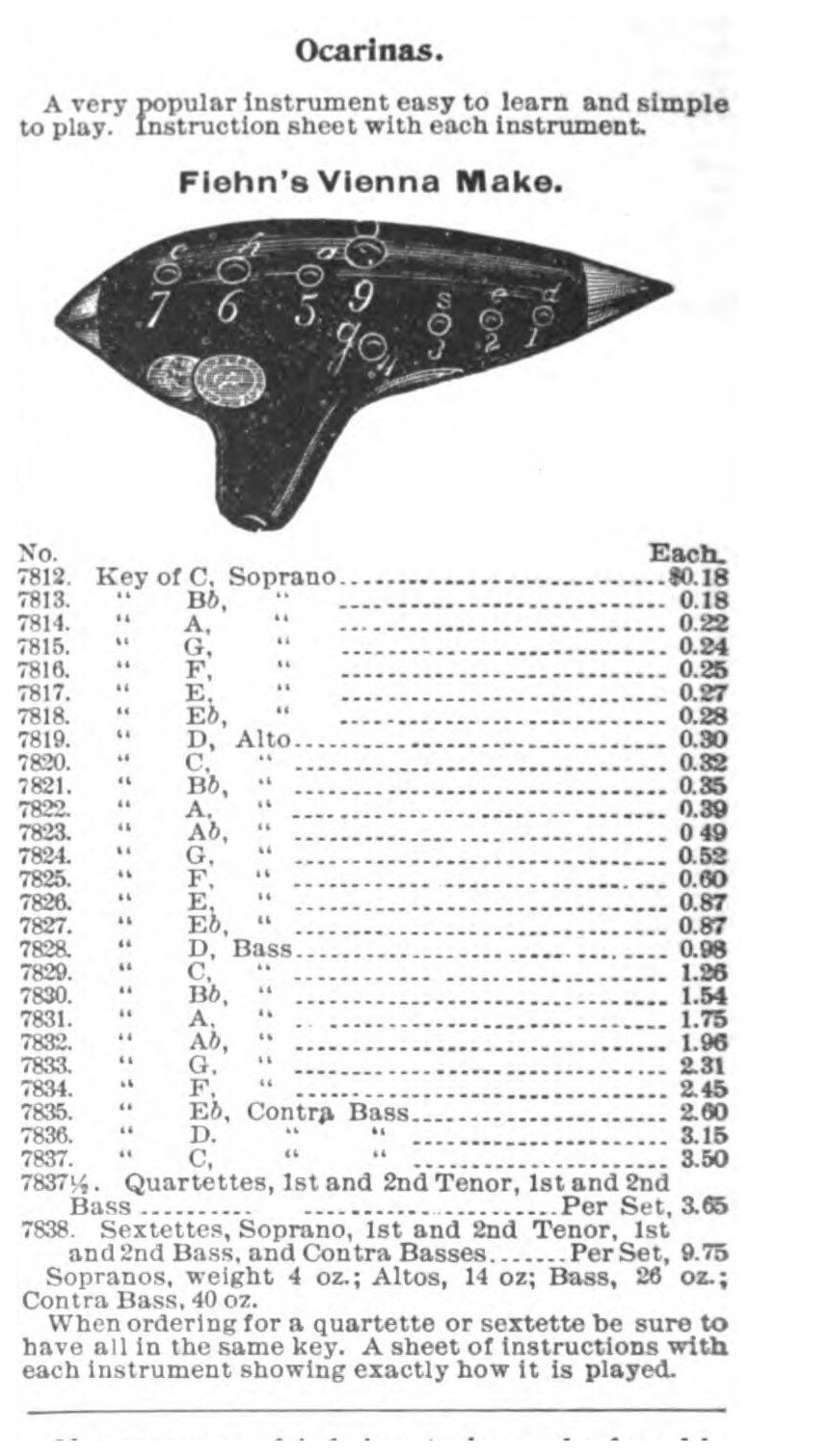
Catalog numbers 7812–7838, from Key of C, Soprano, $0.18 down through the altos, basses, and an E♭ contra bass at $2.60, then “Quartettes, 1st and 2nd Tenor, 1st and 2nd Bass” at $3.65 the set and “Sextettes” at $9.75. The weights are given at the foot: sopranos 4 oz, altos 14 oz, bass 26 oz, contra bass 40 oz.
The same catalog sells an ocarina method by mail, nine pages later, in a run of Ryan’s instructors between the double bass and the harmonica:
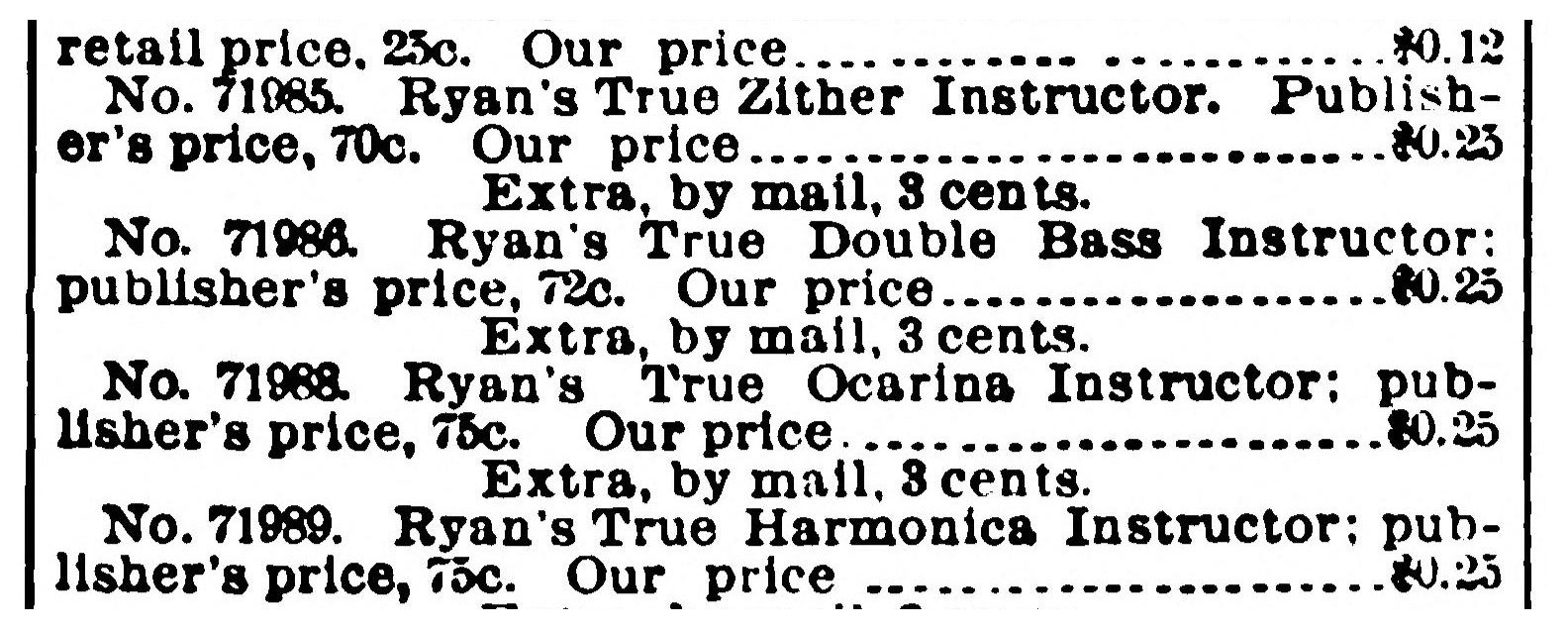
No. 71988. Ryan’s True Ocarina Instructor; publisher’s price, 75c. Our price $0.25. Extra, by mail, 3 cents.
Sears, Roebuck, 1902 — importing direct, and renumbering
Catalogue No. 111, Spring 1902, page 208.
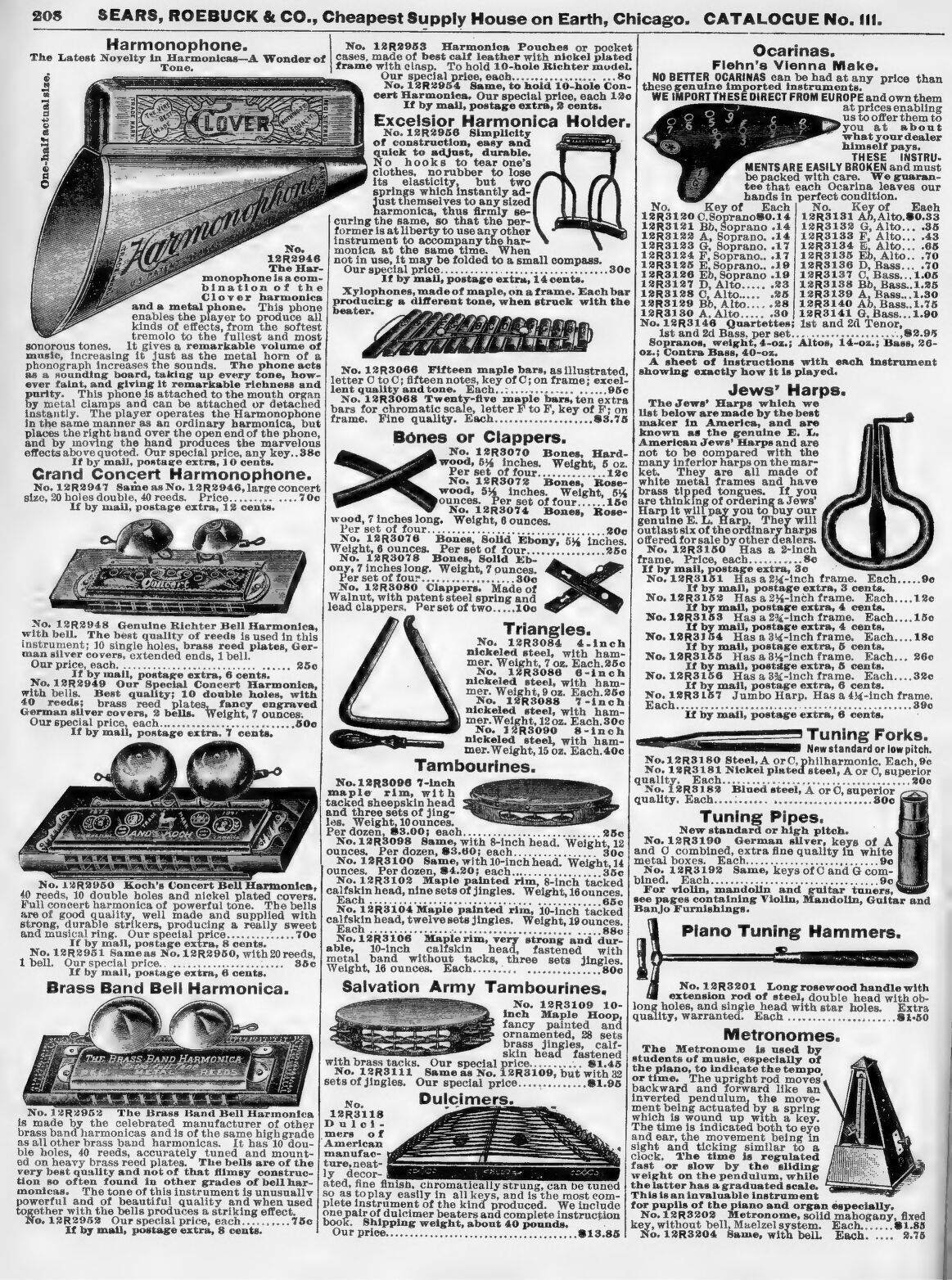
Ocarinas. Fiehn’s Vienna Make. “NO BETTER OCARINAS can be had at any price… WE IMPORT THESE DIRECT FROM EUROPE and own them at prices enabling us to offer them to you at about what your dealer himself pays. THESE INSTRUMENTS ARE EASILY BROKEN and must be packed with care.”
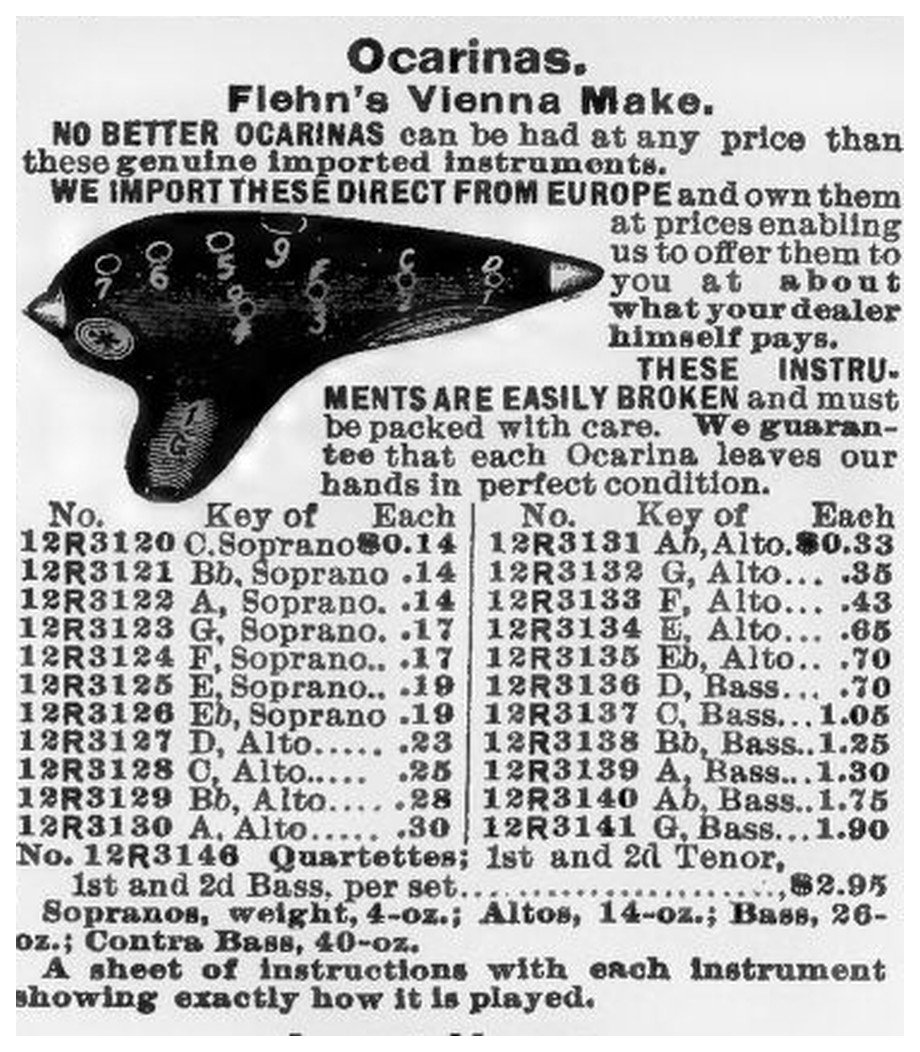
Two trade facts on this page. Sears was importing direct from Europe — “WE IMPORT THESE DIRECT FROM EUROPE and own them at prices enabling us to offer them to you at about what your dealer himself pays” — rather than buying through a domestic wholesaler, which is a different relationship from Bruno’s. And Sears numbered the line itself: 12R3120 to 12R3141, with 12R3146 for the quartettes, where Bruno and Williams printed the Viennese runs.
Twenty-two sizes, C soprano at 14¢ down to G bass at $1.90, and the shipping weights beneath: “Sopranos, weight, 4-oz.; Altos, 14-oz.; Bass, 26-oz.; Contra Bass, 40-oz.” — though no contra bass is actually listed in the prices. The instruction sheet is there too: “A sheet of instructions with each instrument showing exactly how it is played.”
Sears, Roebuck, 1911 and 1912 — still selling, no longer naming
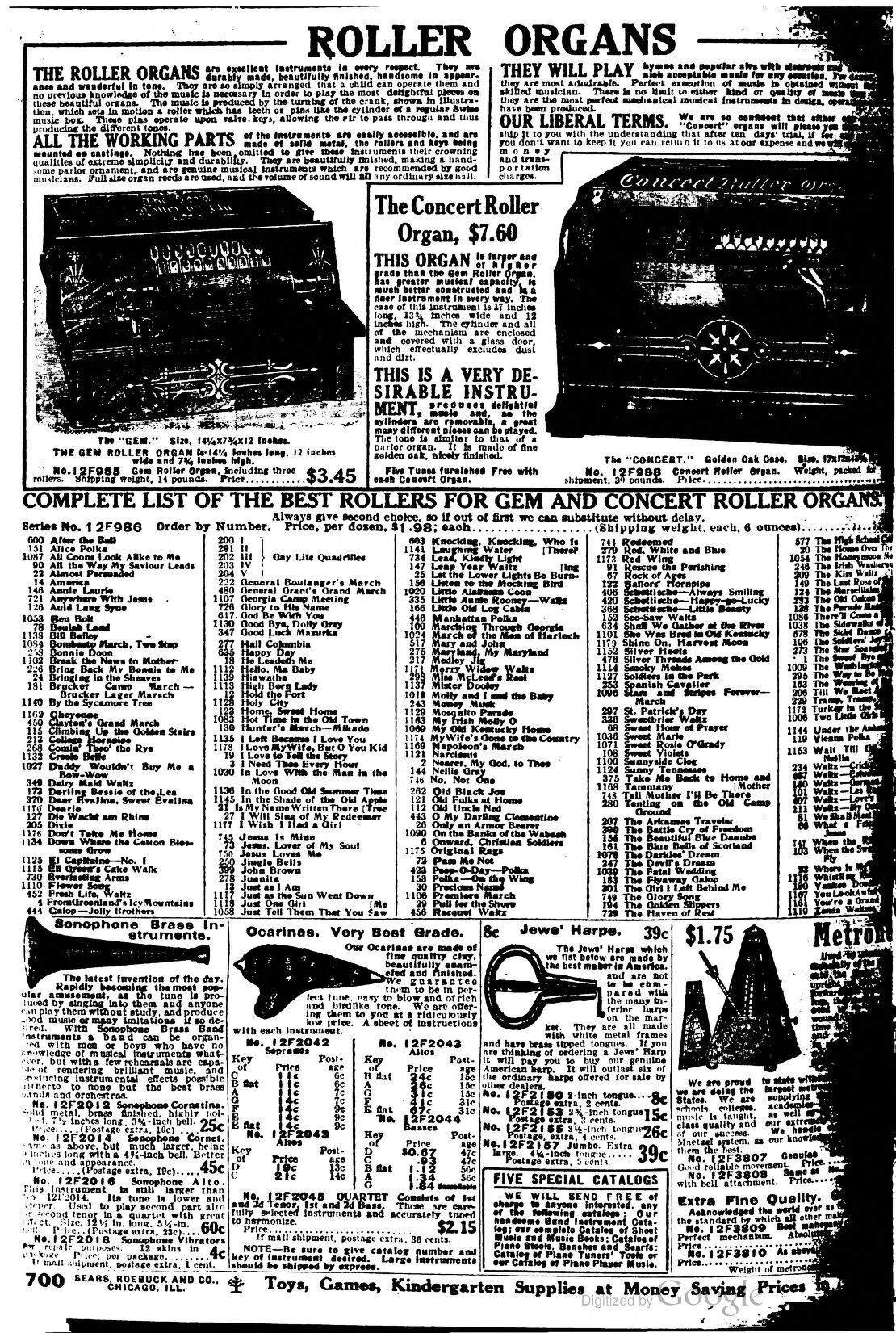
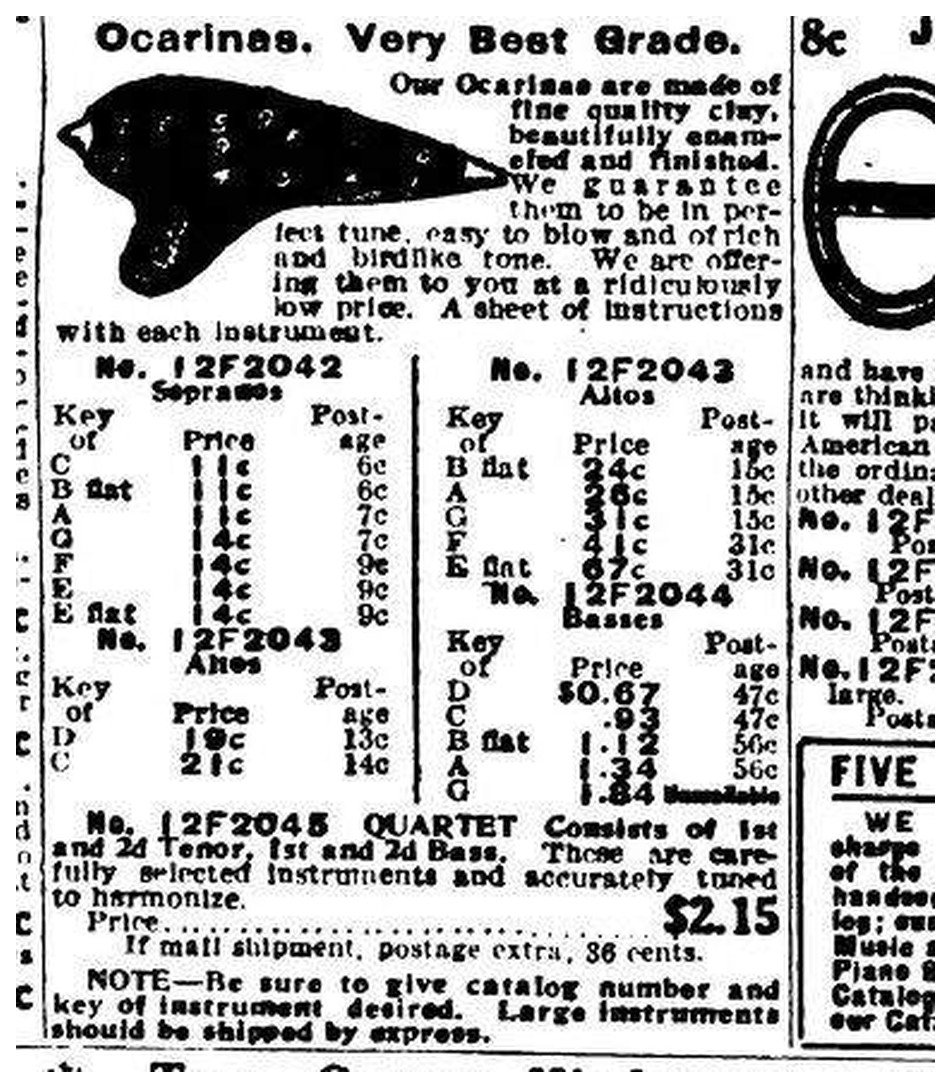
Ocarinas. Very Best Grade. “Our Ocarinas are made of fine quality clay, beautifully enameled and finished. We guarantee them to be in perfect tune, easy to blow and of rich and birdlike tone. We are offering them to you at a ridiculously low price. A sheet of instructions with each instrument.”
No. 12F2045 QUARTET. “Consists of 1st and 2d Tenor, 1st and 2d Bass. These are carefully selected instruments and accurately tuned to harmonize.” $2.15
“NOTE — Be sure to give catalog number and key of instrument desired. Large instruments should be shipped by express.”
Four stock numbers: 12F2042 sopranos, 12F2043 altos, 12F2044 basses, and 12F2045 the quartet — sopranos from 11¢, the G bass at $1.84 and marked unmailable.
Catalog No. 124 of 1912 repeats the copy almost word for word, down to the ridiculously low price, at 12H2042–12H2045: the letter moves with the catalog number while the digits stay. Its index lists Ocarinas at pages 344–346. A settled house product, not one season’s omission.
The same section names origins freely for everything else — “Genuine American”, “French Instruments”, “German”, “Genuine Rogers”, “Genuine Paquet”. The ocarinas alone are anonymous.
So between 1902 and 1911 the ocarina stopped being a named Viennese import at Sears and became an unattributed commodity. That is a claim about Sears, with a document on either side of it. It is not a claim about the American trade, and it is not a claim about Fiehn (see below).
Montgomery Ward, 1916 — “Genuine Vienna Ocarinas”
Catalogue No. 132, page 484.
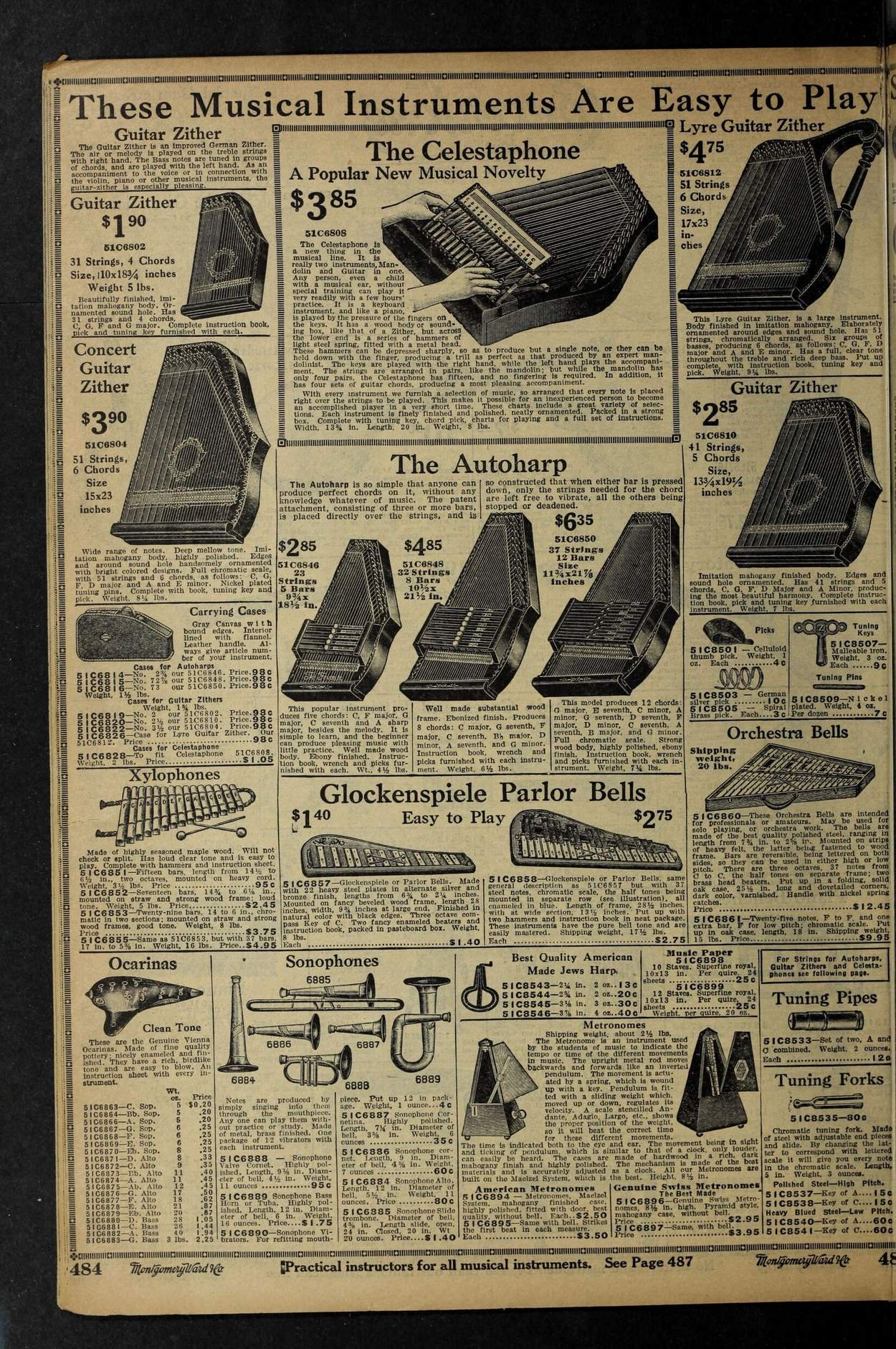
Ocarinas. “These are the Genuine Vienna Ocarinas. Made of fine quality pottery; nicely enameled and finished. They have a rich, birdlike tone and are easy to blow. An instruction sheet with every instrument.”
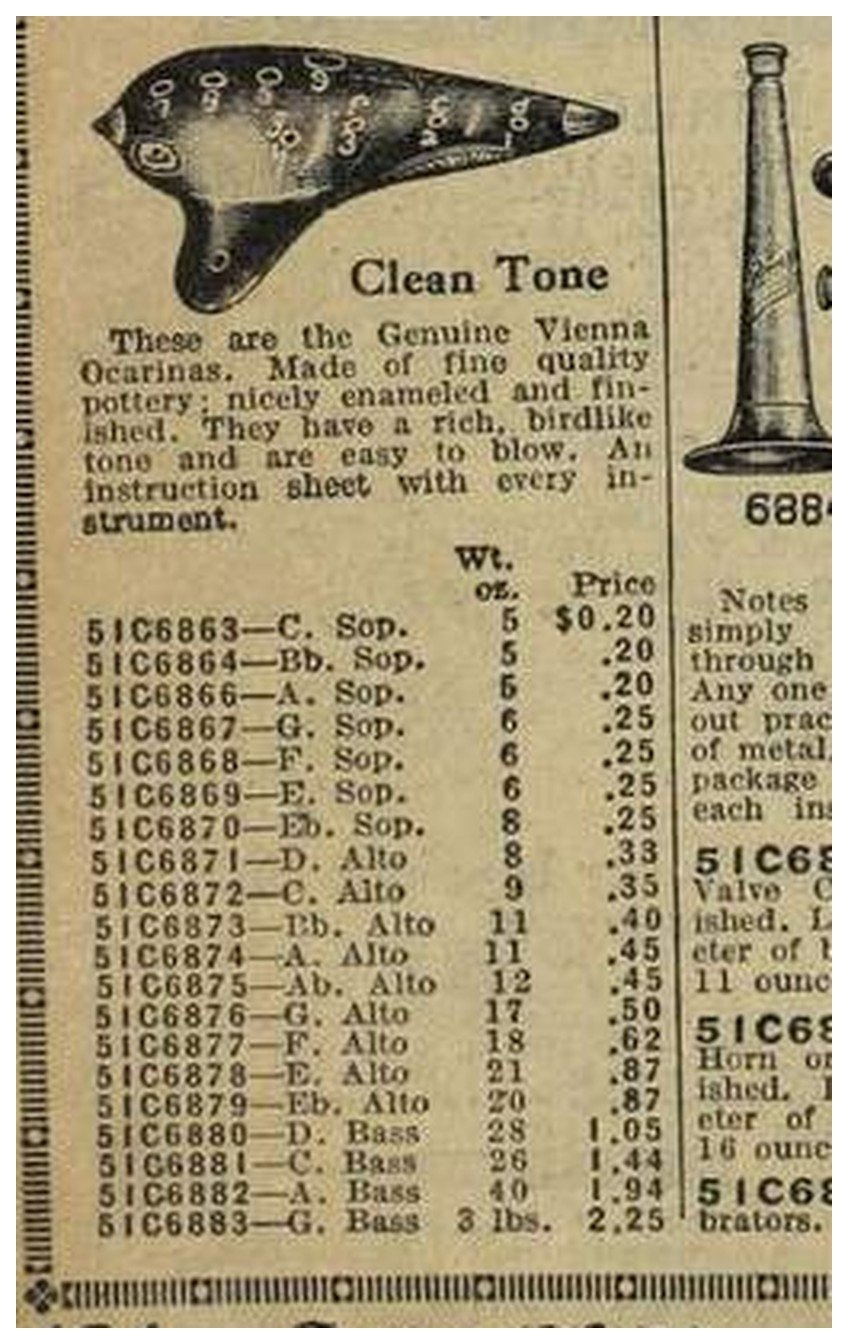
Twenty sizes, from 51C6863—C. Sop., 5 oz., $0.20 down through the sopranos and altos to 51C6883—G. Bass, 3 lbs., $2.25, with a shipping weight printed against each one. The run is 6863 to 6883 with 6865 skipped.
Montgomery Ward, 1929 — “Genuine H. Fiehn Ocarinas”
Catalogue No. 111, Fall & Winter 1929–30, page 461.
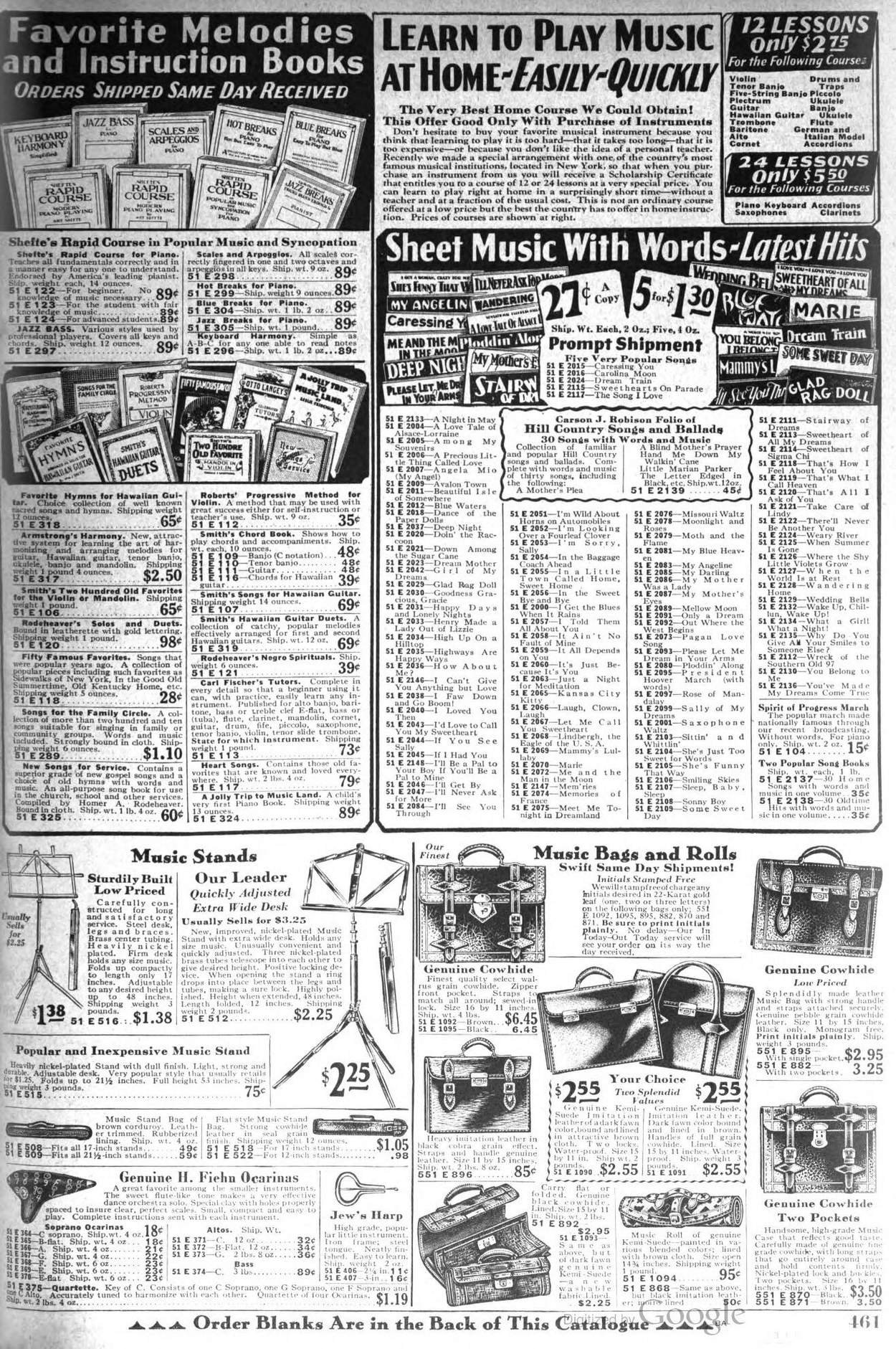
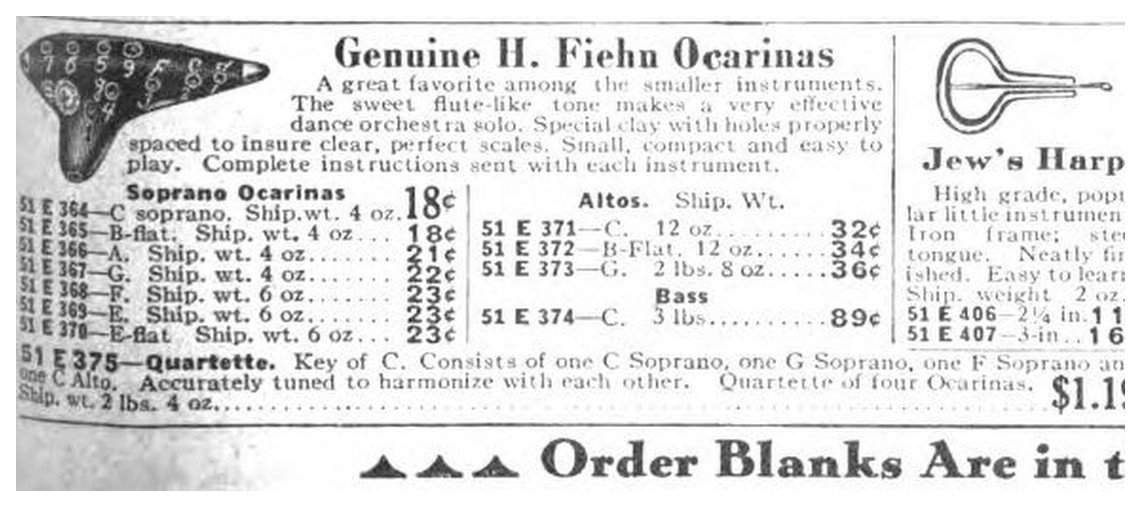
Genuine H. Fiehn Ocarinas. “A great favorite among the smaller instruments. The sweet flute-like tone makes a very effective dance orchestra solo. Special clay with holes properly spaced to insure clear, perfect scales. Small, compact and easy to play. Complete instructions sent with each instrument.”
Twelve items, 51 E 364 to 51 E 375: sopranos C, B♭, A, G, F, E, E♭ from 18¢; altos C, B♭, G; a C bass at 89¢; and a Quartette in C — “one C Soprano, one G Soprano, one F Soprano and one C Alto. Accurately tuned to harmonize with each other” — $1.19.
Montgomery Ward was printing “H. Fiehn” in 1929, thirty-two years after the earliest Sears page above that prints the name, and at least eighteen years after Sears had stopped.
Sears, Roebuck, 1929–30 — “Our ocarinas are imported”
Catalog No. 159, Fall and Winter 1929–30, page 736 — the same season as the Ward page above.
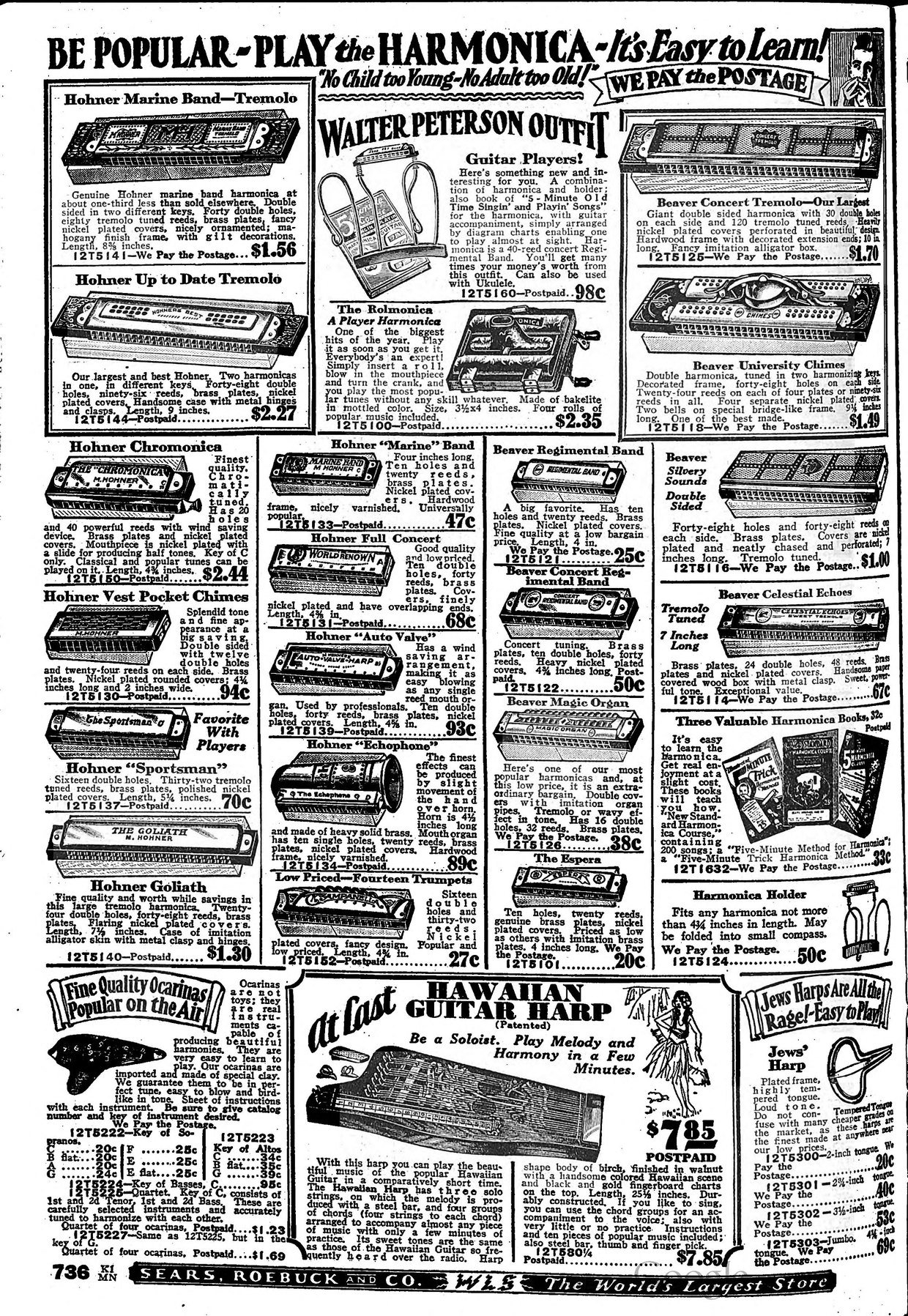
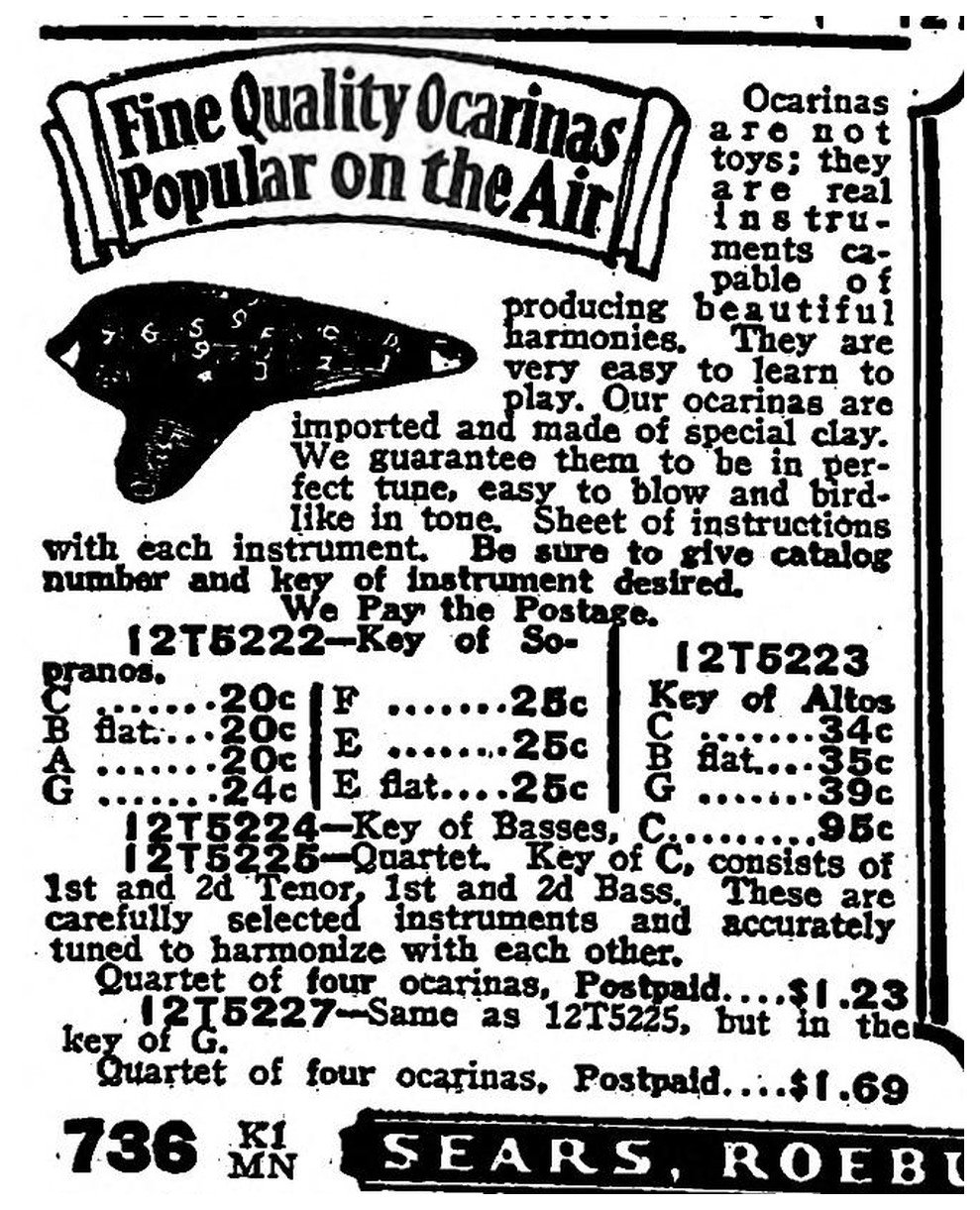
Fine Quality Ocarinas — Popular on the Air. “Ocarinas are not toys; they are real instruments capable of producing beautiful harmonies. They are very easy to learn to play. Our ocarinas are imported and made of special clay. We guarantee them to be in perfect tune, easy to blow and bird-like in tone. Sheet of instructions with each instrument.”
Sopranos at 12T5222 from 20¢, altos at 12T5223, a C bass at 12T5224 for 95¢, and two quartets — 12T5225 in C at $1.23 and 12T5227 in G at $1.69.
Ward’s page and this one are from the same season, and one names H. Fiehn while the other names no maker. What a catalog prints is a fact about that catalog, not about the instrument or the man who made it.
The heading, Popular on the Air, is a 1929 claim about radio.
Montgomery Ward’s wording, 1916–1929
| year | how Ward describes them |
|---|---|
| 1916 | “Genuine Vienna Ocarinas” — the city |
| 1920 | “Learn to Make Good Music in a Few Hours’ Time” — nothing |
| 1921 | “Ocarina”, beside the Celestaphone — nothing |
| 1922 | “Ocarinas… All Keys” — nothing |
| 1923 | “Imported Ocarinas” — foreign origin asserted, unnamed. 13 sizes |
| 1924 | “A very popular instrument with a most pleasing tone” — nothing |
| 1926, 1927 | none at all |
| 1929 | “Genuine H. Fiehn Ocarinas” — the maker |
Across thirteen years, one house used seven different wordings, and in two years it listed no ocarinas. Whether the changes were Ward’s copywriter, a change of supplier, or something Fiehn’s side asked for, none of these pages says.
The 1923 entry is on page 467, headed Wood Wind Instruments, in a small section to the left of the snare drums and below the Laube clarinets and the Meyers System flutes:
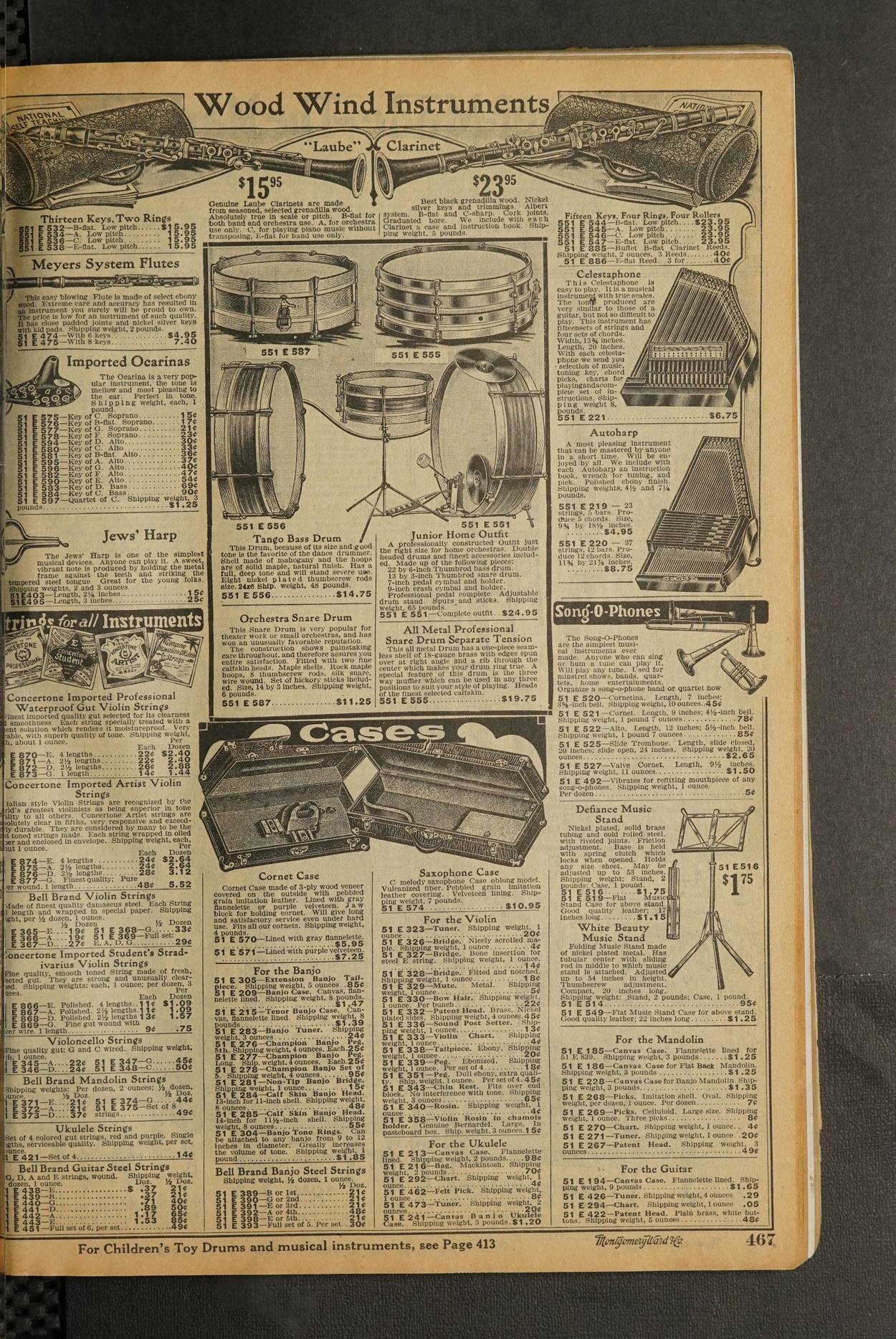
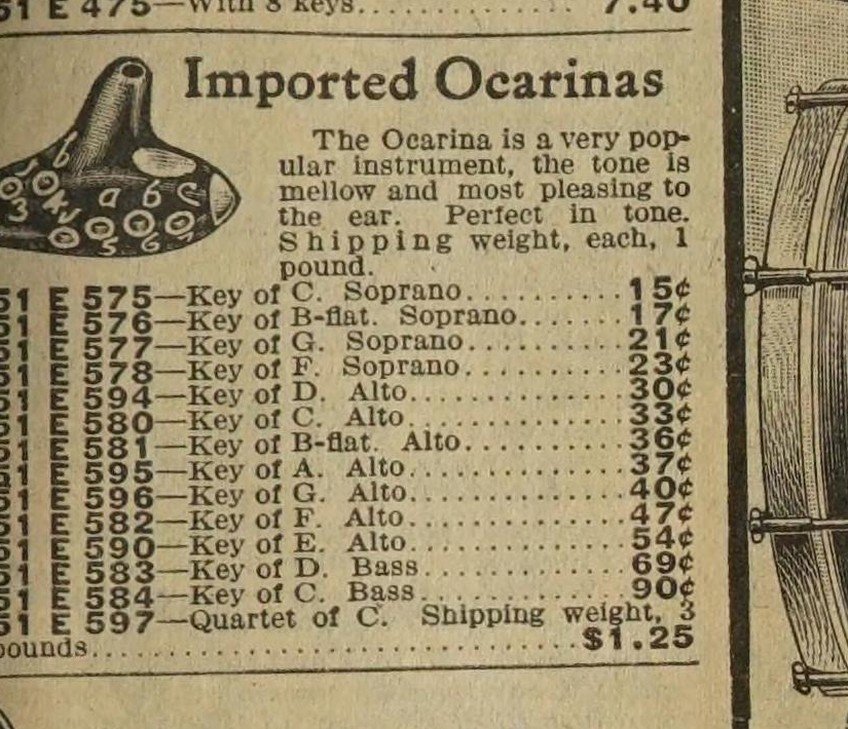
Imported Ocarinas. “The Ocarina is a very popular instrument, the tone is mellow and most pleasing to the ear. Perfect in tone. Shipping weight, each, 1 pound.”
Thirteen sizes and a quartet in C: four sopranos, seven altos, two basses, from 51 E 575—Key of C. Soprano at 15¢ to 51 E 584—Key of C. Bass at 90¢, with 51 E 597—Quartet of C at $1.25. Set against the other two years the museum has counted, Ward’s range narrows steadily: twenty sizes in 1916, thirteen in 1923, eleven in 1929, each count excluding the quartet. Meanwhile the house went from naming the city, to naming nothing, to naming the maker. The range and the copy move independently.
Sears 1922 — the listing survives and the page does not
Catalog No. 144, Spring 1922. The instrument department begins at page 502, and pages 507 to 548 are absent from the scan, which is where the volume’s own index puts the ocarinas, at page 514.
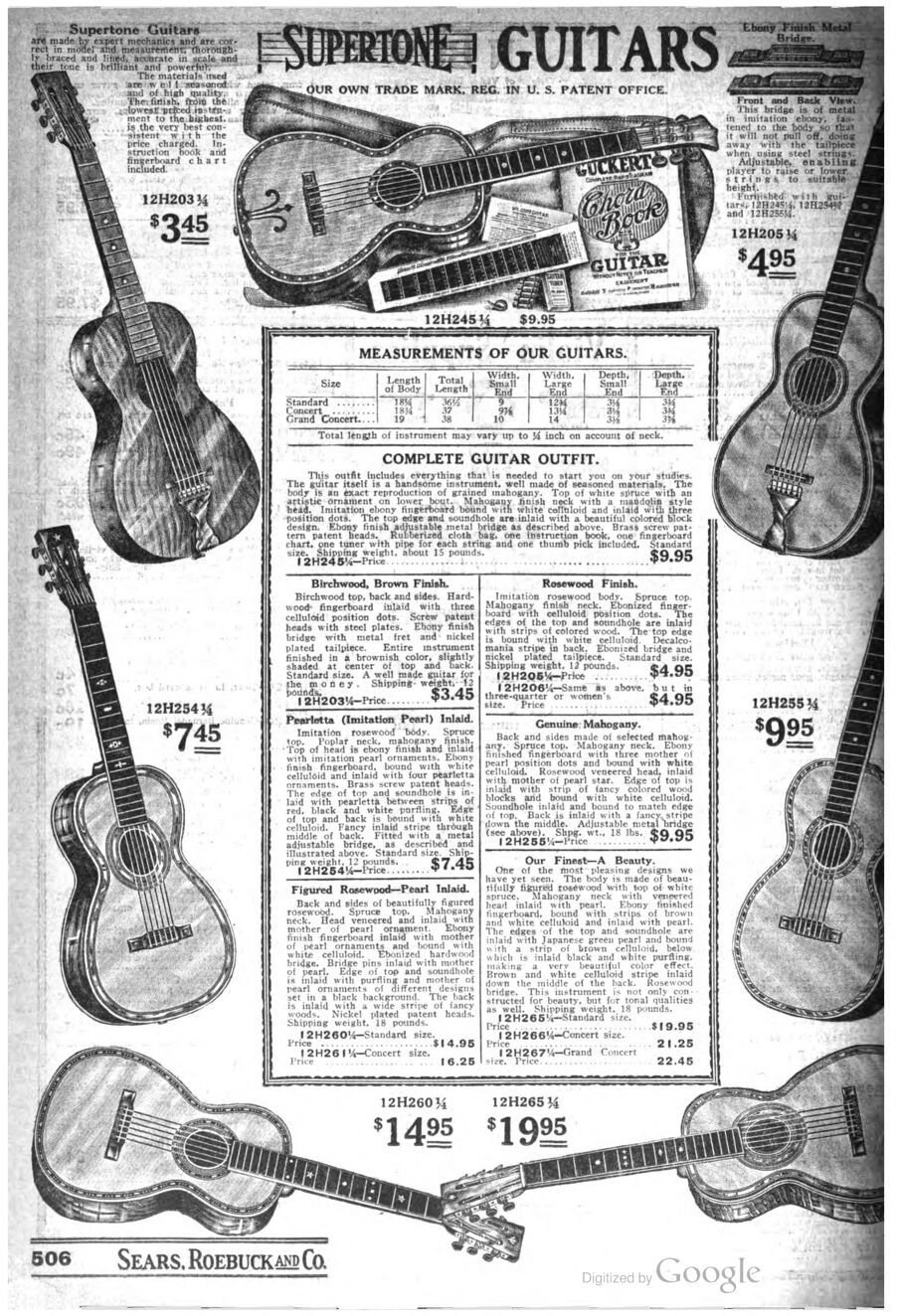
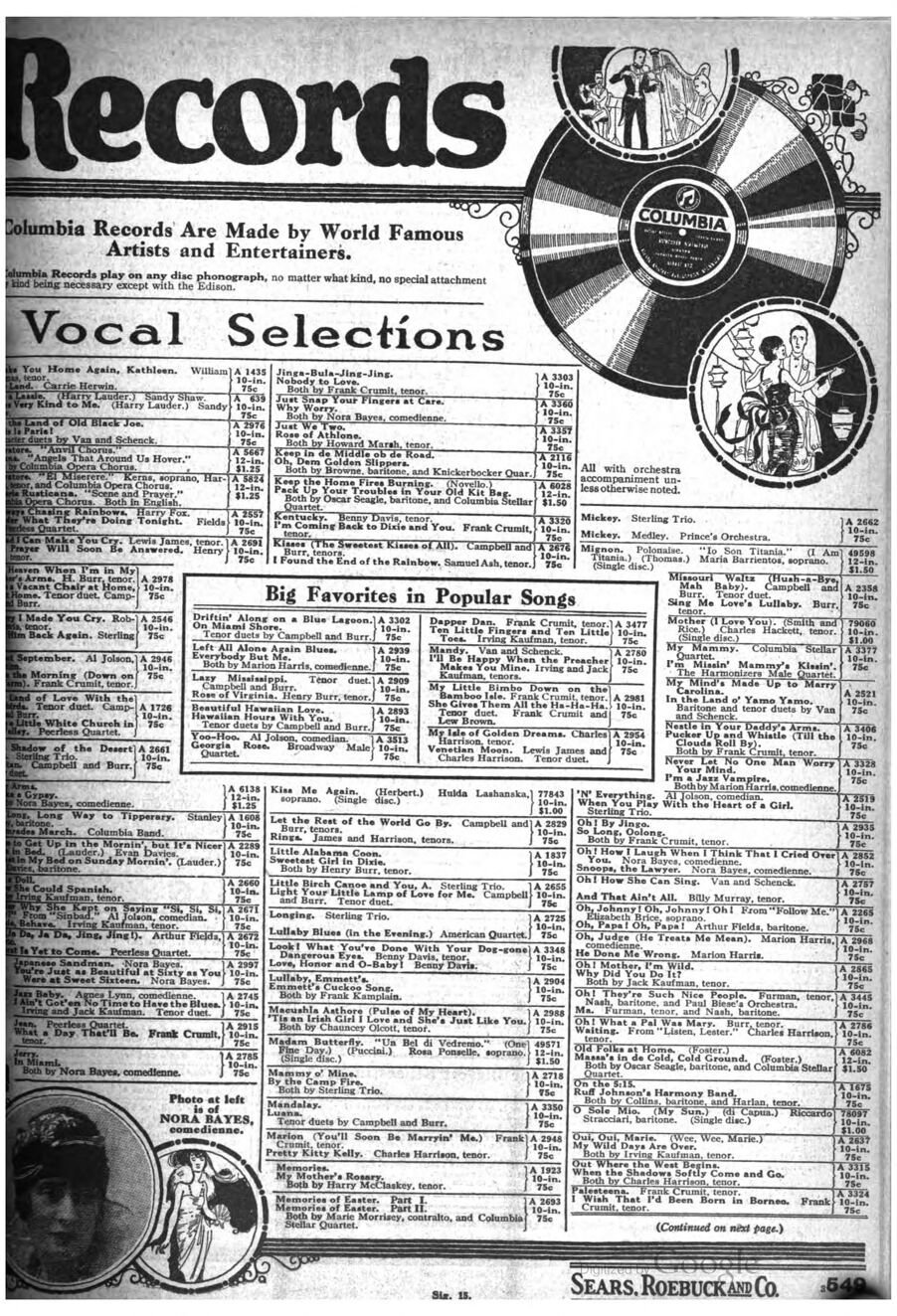
Forty-two pages are missing from the scan, not from the catalog; nothing here says Sears printed no ocarinas in 1922. Both leaves either side of the hole are held, because here the evidence is the discontinuity: a negative that cannot be taken, shown by two pages that should not be adjacent.
What a maker’s absence from a catalog does not mean
A name appearing and then not appearing is the commonest pattern in these tables, and it is tempting to read as a maker’s rise and fall. It is not evidence of one. There are at least four innocent explanations, and “the maker stopped” is not among the likely ones:
- The series stopped, the volume was not digitized, or the scan omits the department. Sears 1922, above, is the last case: the volume is there, with its index, and the pages are not.
- The supplier changed. A name leaving Sears means it left Sears. If it moved to another jobber, the trade did not change; the page did.
- The house changed its own policy. Sears numbered the line into its own stock numbers in 1902 while still naming the maker, and by 1911 named no maker for the ocarinas, while the same section still named the origins of its other instruments.
- The catalog is not the trade. Ward printed Fiehn’s name in 1929–30 in the very season Sears offered the same kind of instrument anonymously.
Fiehn’s instruments in the museum’s collection do not settle the question either. They include Fiehn ocarinas in colored finishes understood to have been made for the American market, stamped “Made in Germany” rather than “Made in Austria”, a stamp whose date the museum has not settled. The readings on file run from the 1938 Anschluss to a German-facing export line decades earlier, and a third party’s label uses the same formula, so the stamp is not by itself a Fiehn attribution. Nothing on this page shows that Fiehn declined after 1911.
What can be speculated
This section goes beyond what the pages state.
The Viennese trade may have reached America through wholesalers first and mail order second. Bruno offers Fiehn’s full range to the trade in 1890; Sears offers him at retail by 1897 and says it imports direct by 1902. That is a plausible sequence from three documents, not an established one — a wholesaler’s catalog surviving from 1890 and a mail-order one from 1897 may say more about what was digitized than about what came first.
Anonymity may be a sign of competition rather than of decline. By 1911 Sears prints no maker, and a house buying from several sources cannot print one name. No document here supports this. It is the question to ask of the next catalog found.
Instructions are promised with the instrument across the catalogs: Sears promises a sheet in 1897, 1902, 1911, 1912, and 1929; Williams gives “methods gratis” in 1911; and Ward promises an instruction sheet in 1916 and “complete instructions” in 1929. The museum holds Fiehn’s own four-language method sheet, which is a sheet of exactly that kind. Which house any particular surviving sheet reached a buyer through is not something a sheet records.
Where the ocarina sat on the page is a claim about what it was taken to be, and the catalogs do not agree. Ward 1916 prints it on a page with the Jew’s harps; Ward 1923 heads it Wood Wind Instruments; Ward 1929 calls its tone “a very effective dance orchestra solo”; and Sears, in the same season, says “Ocarinas are not toys; they are real instruments”.
What is still missing, and what each would fill
| wanted | what it would settle |
|---|---|
| Montgomery Ward Catalog No. 71, 1903 — page 473, item H9313 | What the item is. All four design patents of Winfield S. Frazeur cite this exact page and item as prior art, so a US examiner, between the October 1947 filings and the April 1949 grants, treated a 1903 mail-order listing as the published state of the art. It also falls in the Ward gap, where the museum has 1878 and then nothing until 1916. |
| Any Sears big book, 1913–1928, with its music department intact | The worst gap. Ward listed ocarinas in every volume searched between 1916 and 1924 — 1916 and 1920 through 1924; 1917, 1918, and 1919 have not been searched — and Sears is unknown across most of that span. Not for 1922: its own index lists Ocarinas at page 514, and 514 is inside the missing leaves. |
| Sears Christmas Book, 1958 — page 369, item F, “Little Orby” | A named American mail-order ocarina, in a year nothing above reaches — the latest catalog on this page is 1929–30. A product name can be searched for across other sources in a way that “Ocarinas, Very Best Grade” cannot. |
| C. Bruno & Son catalogs of other years | To date when Fiehn’s keyed (203–206) and ivory-mouthpiece (303–306) lines appeared and disappeared. The Viennese runs match between 1890 and 1911; the ivory line does not appear in Williams at all, and more editions would date its arrival and departure. |
| Modern Plastics, August 1939, p. 25; Playthings, October 1939, p. 13 | When plastic ocarinas reached the trade, and how the toy press described them. Both are cited by patent examiners with page numbers. |
| A Sears catalog of 1905 or 1908 | When Sears stopped naming the maker, which is now bracketed only between 1902 and 1911. The Internet Archive’s volumes for these years are not usable: its 1902 and 1910 are hardware editions with no instrument department, and its 1908 is a modern facsimile that is access-restricted. |
When a negative counts
A catalog without ocarinas says something only if its instrument pages are all there, and Sears 1922, above, shows a scan where they are not. So the museum checks for a neighbor on the same page rather than counting instruments across the whole book. Ocarinas and Jew’s harps are printed together in Sears 1902, 1911, and 1929 and in Ward 1916, 1923, and 1929: six catalogs, two houses, twenty-seven years. A volume that shows no Jew’s harps has most likely lost the page they share, and a count taken across the whole book will not notice.
Where these catalogs are
Every page quoted and every page image above is from the Internet Archive, which serves all of these volumes in full; they are long out of copyright. The identifiers are below, and the museum holds its own copy of each.
A scan’s text layer cannot be trusted alone. One Sears scan the museum searched, a 1970 reprint of the 1927 catalog, was read by a machine set for the wrong script and returns nothing for Sears or shoes, let alone ocarina; the 1922 scan above is missing forty-two pages of its music department. Every quotation above was checked against the page image.
| house | edition | Internet Archive identifier |
|---|---|---|
| C. Bruno & Son, New York | Illustrated catalogue, 1890 | illustratedcatal00cbru |
| Hamilton S. Gordon, New York | 1897 | hamilton-s.-gordon-1897 |
| R. S. Williams, Toronto | Catalogue no. 32, 1911 | catalogueno32ofm00rswi |
| Sears, Roebuck | Consumers Guide No. 104, Spring 1897 | sears-roebuck-catalog-104-spring-1897 |
| No. 111, Spring 1902 | sears-roebuck-catalogue-111 |
|
| No. 122, Spring 1911 | sears-roebuck-catalog-122-spring-1911 |
|
| No. 124, 1912 | catalogno12400sear |
|
| No. 144, Spring 1922 — the volume with the gap | SearsRoebuckAndCoCatalog1922 |
|
| No. 159, Fall and Winter 1929–30 | sears-roebuck-catalog-159-t-1929-30 |
|
| Montgomery Ward | 1916 | montgomerywardca1916mont |
| 1920 · 1921 · 1922 | montgomerywardca1920mont · 1921 · 1922 |
|
| 1923 · 1924 | montgomerywardca1923mont · 1924 |
|
| No. 104, Spring and Summer 1926 | montgomery-ward-catalogue-104-1926-spr-sum |
|
| 1927 | montgomerywardca1927mont |
|
| No. 111, Fall and Winter 1929–30 | montgomery-ward-catalogue-111-1929 |